If you cannot see the graphic or access the links within this message please go to the source
|
 |
The art of the deal – M&A finding value in a flat market
The volume of activity in the direct real estate market may remain disappointingly weak, but corporate activity over the last 18 months tells a different story. London Metric’s absorption of LXi REIT and Urban Logistics REIT, the merger of Tritax Big Box and UKCM, PHP’s takeover of Assura, and the acquisition by New River of Capital & Regional all suggest that some of the best management teams out there see compelling value in the market.
Of course, it can be argued that it is the wider equity market’s suspicion of property valuations that has been the catalyst for these deals, rather than a newfound and broad appreciation of value in the sector. Many such deals have been completed at a discount to underlying asset values, meaning that the buyers only needed to believe current valuations to deliver an immediate paper return on their investment.
Nonetheless, confidence in current valuations is one of the key foundation stones to a broader-based recovery. Rental values, which are supported by a greater depth of evidence, have been trending upwards across much of the market, so a growing belief that multiples are on firmer ground would allow for capital values to move confidently in the same direction. |
What is most notable about these deals is the wide range of property assets involved. It is not merely a story of one or two hot sub-sectors, rather it is a reflection that we are at a stage of the cycle where asset values in general are a lot more likely to be higher in three years’ time than they are to be lower.
Cyclical risk was high in 2021/22, with values predicated on low interest rates, which could only really go in one direction. Rates are now in what might be considered a “normal” range in a long-term context, and asset values have adjusted by around 20-25% to reflect the journey from A to B. Rates impact therefore has been significantly reduced as a go-forward risk, even if we see little further base rate compression from here.
The greater risk now relates to the impact of structural change, a risk that can be mitigated by careful stock selection and decisive asset management, which those acquisitive management teams will be confident they can deliver. |
|
Commercial property returns
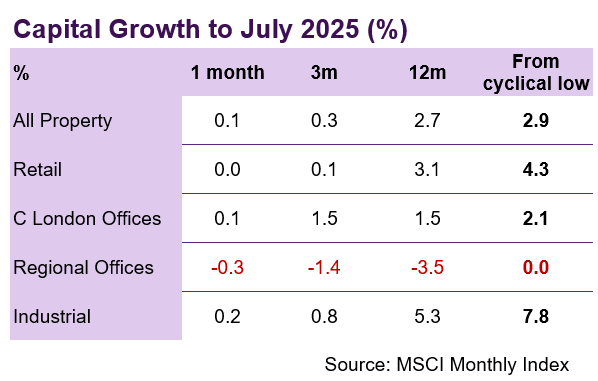
According to MSCI, average commercial property values edged up by 0.1% again in July, taking the cumulative recovery to 2.9% since last Spring. However, the rate of growth has slowed to a crawl, from a quarterly rate of 1.5% at the end of last year to just 0.3% over the last 3 months. Values on average are still almost 23% below their June ’22 peak.
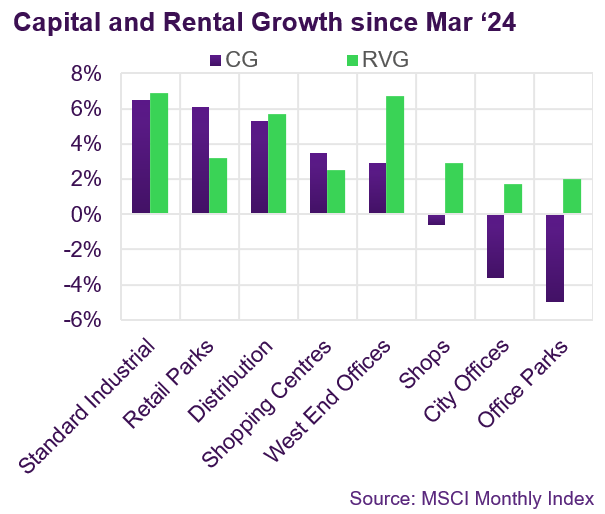
Capital growth remains strongest in the Industrial sector, although the quarterly growth rate has also slowed significantly, from 2.8% in Q4 to 0.8% over the last 3 months. The trend growth rate has slowed most for distribution (0.4% over 3 months) compared to standard Industrial (0.9%). Both sub-sectors continue to report robust rates of rental growth.
The office sector remains notable for the wide spread of returns even across neighbouring sub-regional locations. For example, West End values are up by 2.9% this year, whilst in the City they are marginally down (-0.1%), and in Outer London they have fallen a further 4%. In Scotland, values are up 1.3% this year but remain 40% below June ‘22 levels.
Most retail formats are recording moderate levels of capital growth. Retail Parks were leading the way, with year-on-year growth of more than 6% earlier this year but have run out of steam in recent months. Value recovery for retail units and supermarkets has been slower to arrive, but recent signs are slightly more promising, with quarterly capital growth of 0.7%. |
Investment market activity
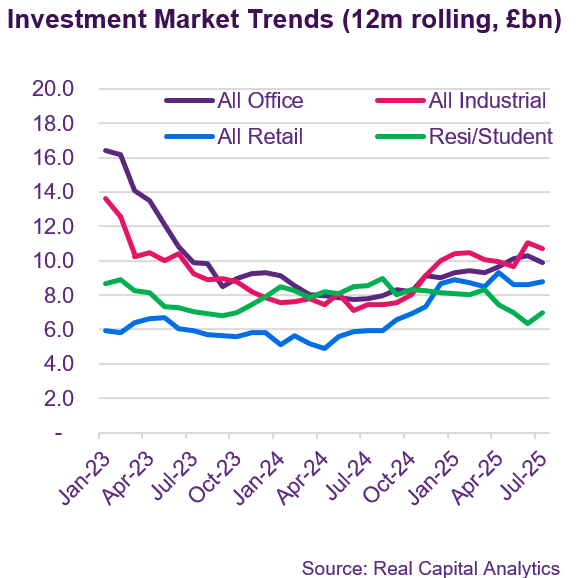
Preliminary data from Real Capital Analytics indicate that £2.4bn of transactions completed in July. This is a disappointing figure after a relatively string June, even if July is often a relatively quiet month. The YTD total of £22.6bn is around 10% lower than the same period last year, and barely half the total from the same period in 2022.
The beds sectors dominated the largest deals in July, most notably the acquisition by QuadReal of a PBSA portfolio from Apollo for £500m. The portfolio, comprising 3,450 beds across 8 assets, was previously reported by React News to be under offer at £560m in May. Elsewhere, Goldman Sachs and Generation Estates acquired a 435 bed PBSA block in Southampton from Vita Student Housing for £86m.
Single-family (rental houses) has been taking an increasingly large share of Build-to-Rent investment this year. This trend is exemplified by a £100m commitment from the JV between Kennedy Wilson and CPPIB to acquire 275 new homes in Milton Keynes, Derby and Cheltenham.
One of the most iconic office buildings in the country has traded for only the second time in its history as the Royal Liver Building in Liverpool was sold for £57m. The building, which was put up for sale in March 2022 for £90m, was acquired by Princes Foods, one of the occupiers.
Supermarket Income REIT continued to target the largest format stores, acquiring a 93,000 sq ft Tesco in Ashford for £54m. The 7% initial yield reflects a relatively short 9-year unexpired term. Elsewhere, US REIT WP Carey acquired two mid-sized Morrisons in the East Midlands for £51m. |
Market yields
The benchmark ten-year Gilt yield has gone through a period of volatility in recent months as economic data has painted a picture of tepid growth and sticky inflation. At almost 4.75% at the time of writing, the widely referenced risk-free rate is circa 80bp higher than it was this time last year.
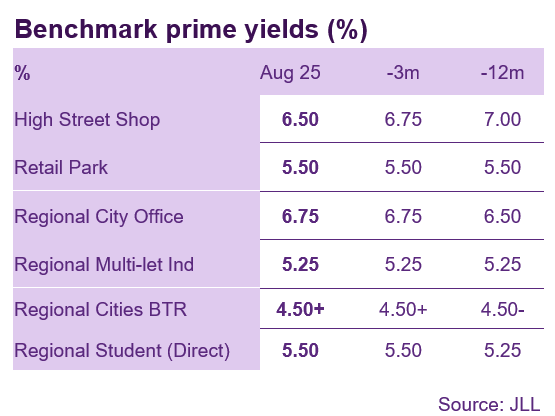
JLL only made one change to their benchmark yields in the last month, with the prime benchmark for Solus Retail Warehouses brought in by 25bp to 6.0%. One example of a retail warehouse trading even keener than that was the sale by Tritax Big Box of a B&Q in Romford to CBRE IM for £33m, representing a net initial yield of 5.5%.
With the supermarket benchmark remaining at 5.25%, the differential between a prime supermarket and a prime retail warehouse is now just 75bp. Given that the former benchmark reflects a longer index-linked lease, that premium looks narrow, perhaps reflecting the high levels of stock being brought to market by Asda and Morrisons.
The cut to base rate in August was widely predicted, but the narrow split in the vote has cast some doubt on the extent of further reductions. The five-year swap rate was little changed on the month, at 4.2% at the time of writing. The forward curve implies a terminal rate of 4.5% or 4.75%, with the next (and perhaps final) cut expected around the end of the year. |
Auctions
A notable feature of Allsop’s commercial auctions this year has been the significance of post auction sales. The July auction illustrates this trend, with moderate sales proceeds by the end of the auction boosted 25% by post auction sales. The May and June auctions saw similar levels post auction, perhaps reflecting the difficulty of setting guide prices in a thin market.
Allsop’s noted the wide range in initial yields in Retail lots, reflecting the extreme differences in reversionary potential. Stronger high street locations are starting to see meaningful reversion, whilst in contrast, weaker assets at the tail end of long leases are still exposed to significant over-rentedness. |
Market forecasts
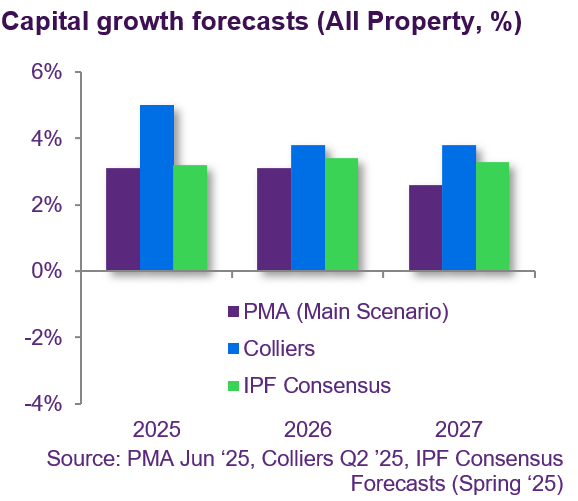
Property agency Colliers released their latest forecast outlook in June, slightly upgrading their previous predictions. They anticipate 5% capital growth this calendar year, implying a significant acceleration on the 1% recorded over the first seven months. Their 5-year outlook is for a very healthy 3.4% per annum, which they expect to be supported by 2.7% p.a. rental growth.
Colliers predict that the Industrial sector will continue to outperform, with robust capital growth of 5.8% this year contributing to 3.8% per annum over a five-year horizon. Their forecast does not rely on material yield compression, with value appreciation expected to be fully underwritten by rental value growth.
Colliers do see some potential for yield compression in the office sector, with equivalent yields expected to come in by 60bp. Supported by moderate rental growth of 2.2% per annum, they anticipate capital growth of 3.1% p.a. through to 2029. They note however, that rental growth will be driven by prime assets, with little if any growth for secondary/tertiary assets.
The Retail sector is forecast to deliver slightly weaker capital growth (2.8% p.a.), but this is expected to be almost entirely underwritten by rental growth, which would mark a material improvement from the last decade. Notably, Retail is predicted to outperform on a total return basis, at 8.8% p.a. through to 2029. |
Looking forward
It is hard to deny that 2025 has been disappointing so far from an investment market perspective, with underlying trends no better than in 2023 or 2024. The optimism that many felt towards the end of last year was quickly undermined by the tariffs saga, which seems no closer to resolution today than it was on March 1st when President Trump declared that “Trade wars are good and easy to win”.
Domestically, inflation has proven to be stickier than many had hoped, ticking up again in July to further reduce expectations for rate cuts. Yet paradoxically this may prove to be the catalyst for the market to finally emerge from its slumber and return to the kind of investment levels we would expect to see as part of a broad-based cyclical recovery.
Many seem to have been waiting for the best part of three years for some sort of sign. Waiting for elections, waiting for budgets, most of all waiting for lower interest rates. However, markets are now implying that we are close to the bottom of the interest rate cycle, with only one or two further quarter point cuts expected. The benchmark five-year SONIA swap rate is 3.8% at the time of writing, not far below the current base rate, but also not far above the lower end of a range it’s occupied since late-2022. At these rates, moderate leverage can be accretive again, and competition amongst lenders means that debt availability is likely to be a tailwind rather than a constraint for the next phase of the cycle. Occupiers are also doing their bit, despite the flat economy, with healthy levels of take-up squeezing availability and encouraging rental values upwards across a large cross-section of the market. Conditions then seem set fair for a recovery. The last missing ingredient is the re-emergence of the “animal spirits” identified by John Maynard Keynes – in his words “a spontaneous urge to action rather than inaction” that will finally spark the market back to life. |
Visit us
Discover a wealth of
real estate expertise, regardless of your business level or stage.
 |
|
|
If you would like to opt out, please get in touch with your Relationship Manager.
The Royal Bank of Scotland plc, The Royal Bank of Scotland N.V, or an affiliated entity (‘RBS’) and for the purposes of Directive 2004/39/EC has not been prepared in accordance with the legal and regulatory requirements to promote the independence of research. Regulatory restrictions on RBS dealing in any financial instruments mentioned at any time before this document is distributed to you do not apply. This document has been prepared for information purposes only. It shall not be construed as, and does not form part of an offer, nor invitation to offer, nor a solicitation or recommendation to enter into any transaction or an offer to sell or a solicitation to buy any security or other financial instrument. No representation, warranty or assurance of any kind, express or implied, is made as to the accuracy or completeness of the information contained herein and RBS and each of their respective affiliates disclaim all liability for any use you or any other party may make of the contents of this document. The contents of this document are subject to change without notice and RBS does not accept any obligation to any recipient to update or correct any such information. Views expressed herein are not intended to be and should not be viewed as advice or as a recommendation. RBS makes no representation and gives no advice in respect of any tax, legal or accounting matters in any applicable jurisdiction. This document is not intended for distribution to, or use by any person or entity in any jurisdiction or country where such distribution or use would be contrary to local law or regulation. The information contained herein is proprietary to RBS and is being provided to selected recipients and may not be given (in whole or in part) or otherwise distributed to any other third party without the prior written consent of RBS. RBS and its respective affiliates, connected companies, employees or clients may have an interest in financial instruments of the type described in this document and/or in related financial instruments. Such interest may include dealing in, trading, holding or acting as market-makers in such instruments and may include providing banking, credit and other financial services to any company or issuer of securities or financial instruments referred to herein. The Royal Bank of Scotland plc. Registered in Scotland No. 90312. Registered Office: 36 St Andrew Square, Edinburgh EH2 2YB. The Royal Bank of Scotland plc is authorised by the Prudential Regulation Authority and regulated by the Financial Conduct Authority and Prudential Regulation Authority. The Royal Bank of Scotland N.V., established in Amsterdam, The Netherlands. Registered with the Chamber of Commerce in The Netherlands, No. 33002587. Authorised by De Nederlandsche Bank N.V. and regulated by the Authority for the Financial Markets in The Netherlands. Agency agreements exist between different members of The Royal Bank of Scotland Group plc.
© Copyright 2024 The Royal Bank of Scotland plc. All rights, save as expressly granted, are reserved. This communication is for the use of intended recipients only and the contents may not be reproduced, redistributed, or copied in whole or in part for any purpose without The Royal Bank of Scotland plc’s prior express consent.
|
|
|