If you cannot see the graphic or access the links within this message please go to the source
|
 |
Retail property is more than just a bargain bucket gamble
A prominent part of the investment case for buying retail property these days is how “cheap” it is. Cheaper than it used to be, cheaper than other property sectors and cheap relative to other asset classes. All these statements are defensible, yet just being cheap is not often a compelling reason to invest in something. If the experience of the retail sector over the last two decades tells you anything, it is that just because an asset looks cheap doesn’t mean its value won’t fall further.
Some very sophisticated investors acquired shopping centres in the immediate wake of the Global Financial Crisis at what were considered at the time to be knockdown prices. Many of these centres have been sold again in recent years with much less fanfare, often for less than half what was paid back then. Relying on bargain hunters has been the downfall of many a retailer, who find that discounts need to get ever deeper to drive volumes, and that potential customers quickly realise that nobody will ever pay “full price”.
Property investors, in the knowledge they will likely need to resell the asset at some point, want to have confidence that the price they are paying is underpinned by something more fundamental than a notional “discount”. |
This fundamental value is based on an understanding of what tenants are prepared and able to pay to occupy the space. The good news for anyone looking to buy retail today is that the majority of leases have now been reset at rents that are more affordable for retailers. Legacy leases that were signed before the long bear market have burned off, whilst CVAs and insolvencies have removed many more overrented leases from circulation.
According to MSCI, Retail rental values are 14% lower today than they were in 2010. In real terms, that’s a decline of almost 50%. To put it another way, a retailer can sell a pint of milk for 47% more today than they could in 2010, yet they are highly likely to be paying less for their rent than they were then.
Retailers face many other cost pressures of course, but rents are a lot more affordable today than they have been in the past, and that provides a solid basis for selective investment in the sector. |
|
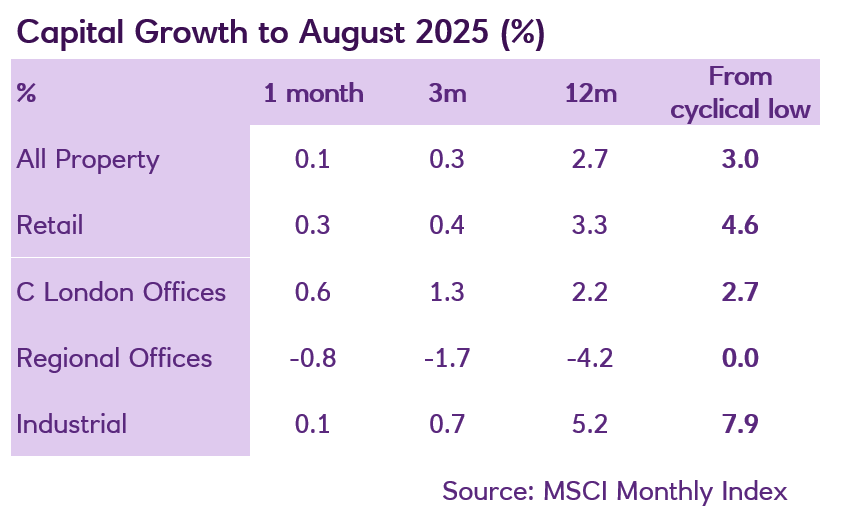
Commercial property returns
According to MSCI, average commercial property values edged up by 0.1% again in August; the fifth successive month in which values have crept up by that marginal amount. On average, commercial property values have increased by 3% from their cyclical low but nonetheless remain almost 23% below the preceding cyclical peak.
Over the last six months, the Central London Office sector has delivered the fastest growth, with average values appreciating by 2.7% since March. In contrast, office values elsewhere have fallen by an average of 3.5% over that same period. Notably, Outer London office values have declined by 4.2% since March, contributing to a decline of 42.5% since 2022.
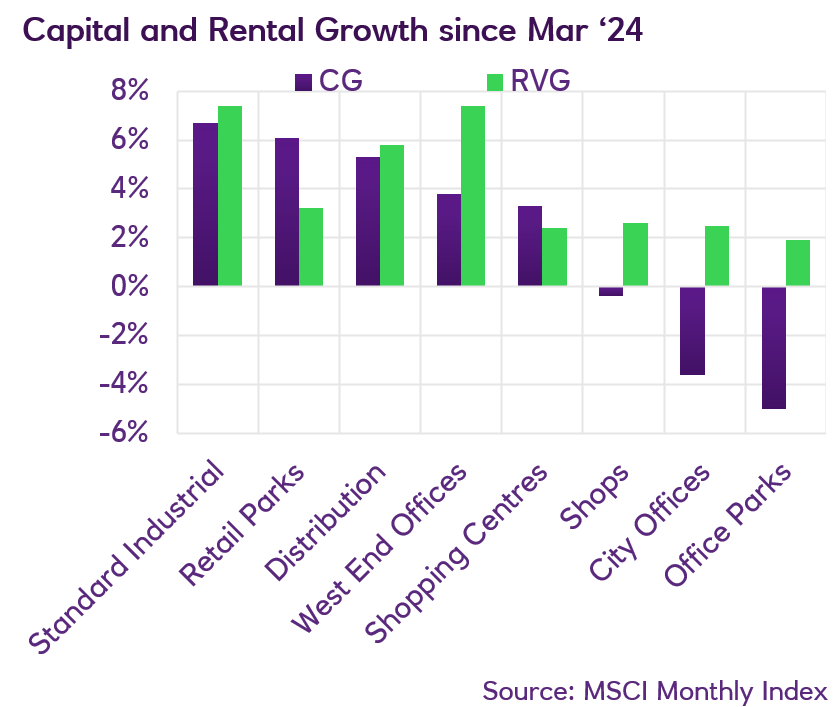
The Industrial sector, which outperformed for much of 2024, is still recording capital growth, but at a much slower rate. Values have risen by 1.6% over the last six months, down from 3.5% over the preceding six. Capital growth remains well supported by rental growth however, with rental values rising by an average of 1.9% over the last six months.
Most retail formats continue to record moderate levels of capital growth. Retail Parks were the first to record a rebound in values, but this has tapered off in recent months. In contrast, shops were late to see any kind of recovery in values, but have seen capital values edge upwards in recent months, supported by tentative signs of rental growth. |
Investment market activity
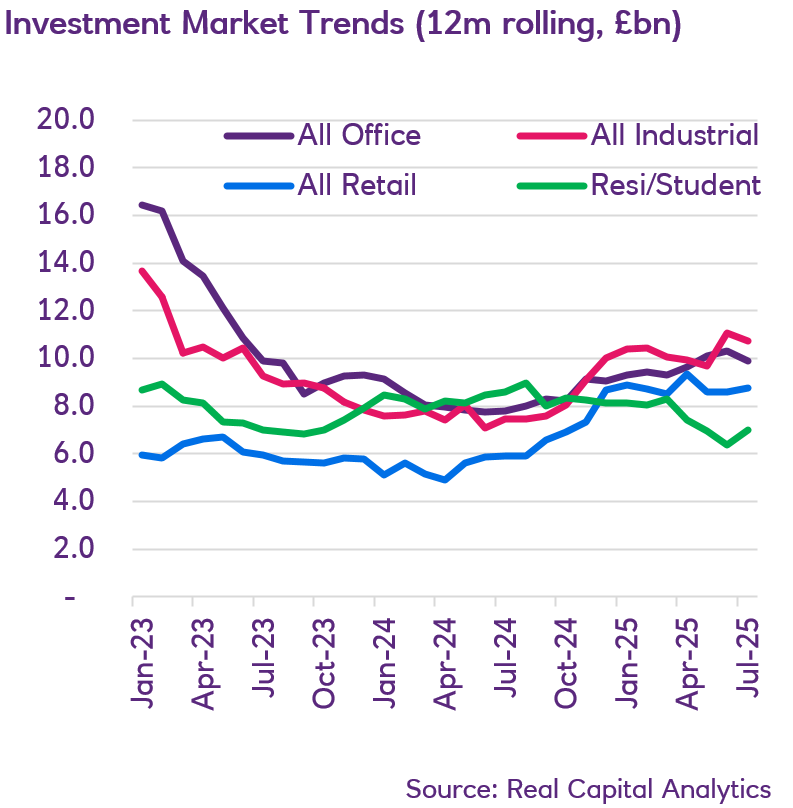
Preliminary data from Real Capital Analytics indicate that £1.5bn of transactions completed in August; a disappointing total even allowing for seasonal factors. The YTD total of £24bn is 15% lower than the same period last year, and barely half the total from the same period in 2022.
By far the biggest deal to close in August was the £319m paid by Hammerson to buy out their JV partner in two Birmingham shopping centres. The purchase of 50% shares in the Bullring and Grand Central from CPPIB is being financed by a share placing of up to 10% of existing issued share capital. The purchase price represents an initial yield of 6.4%.
GIC, the Singaporean Sovereign Wealth Fund, acquired a £120m industrial portfolio out of LGIM’s Industrial Property Investment Fund (IPIF). GIC’s second acquisition for their £500m JV with Chancerygate comprises 17 assets across southeast England, delivering a net initial yield of 5.75% from 78 units at 90% occupancy.
Sirius Real Estate, which operates branded industrial estates in Germany and the UK, acquired Hartlebury estate in Kidderminster for £101m. The 171-acre estate comprises 1.5m sq ft of warehouse space and 17 acres of open storage. The price represents an initial yield of just under 6.5%.
The student accommodation sector remains relatively active, including the debut investment in the sector by private equity investment manager ActivumSG. They paid £84m for 795 beds across five assets to seed a planned £500m platform managed by the Mansion Group. Elsewhere, UOL Group completed a £43.5m sale-and-leaseback from Brighton University, and Barwood Capital committed £30m to a scheme in Birmingham. |
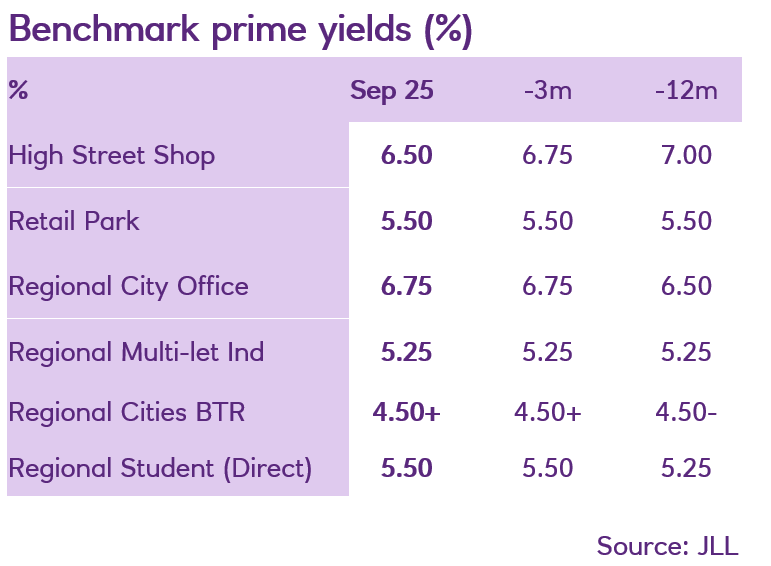
Market yields
Since the 25bp cut to base rate in August, market expectations for further cuts have tempered somewhat. A narrower than expected vote in favour of the August cut, and further signs of sticky inflation have flattened the forward curve, with markets now predicting that the next cut will not take place until early next year. The market is divided on prospects for any subsequent cuts.
Despite increased pessimism on the prospects for further monetary loosening, five-year swaps have remained relatively stable and are still below 4%. In contrast, the benchmark ten-year Gilt yield has moved out by around 25bp over the last month to 4.75%. This represents a 75bp hike over the last 12 months, reducing the risk premium inherent in real estate yields.
Despite the outward shift in the risk-free rate, JLL do not perceive that any of the 52 benchmark yields that they monitor are at risk of softening in the short-term. However, neither do they see much prospect of yield compression. Only prime yields for Central London offices and long-leased hotels are seen as being under any inward pressure.
The Dominant Regional shopping centre benchmark remains at 7.5%, despite the recent transaction involving the Bullring and Grand Central centres in Birmingham. The published sale price suggested an initial yield of 6.4%, although it was also reported to reflect a “topped up” yield of 7.1%. |
Auctions
Data from the Essential Information Group show that commercial auctions have been subdued in the 3 months to August. Making a comparison with the same period last year, the number of lots is down 3.8% and the number of successful sales is down 9.5%, reflecting a success rate of just 66% (down from 70% the previous year). Sales proceeds were down by even more (-18%).
However, Allsop’s September catalogue is the largest to be put out since September ’22 when the market downturn had just started. There are 185 lots listed, with a total combined guide price of £125m. The results of this auction (Sep 30th) will be a useful indicator of investor sentiment as we head into what has historically been the busiest quarter of the year. |
Market forecasts
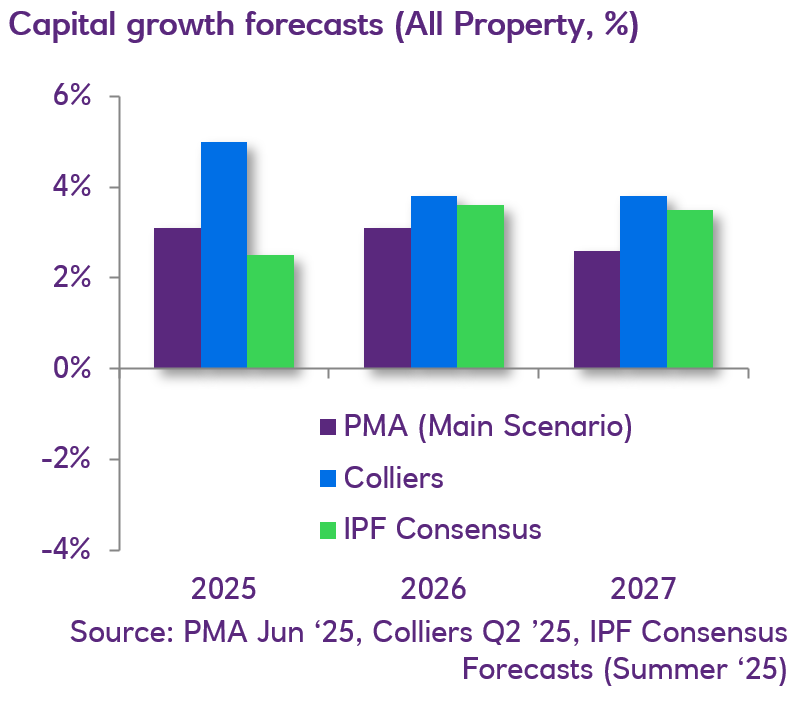
The Investment Property Forum have published their latest Consensus Forecast, showing that contributors have slightly pared back their expectations for capital growth this year (2.5%). Nonetheless, this forecast still implies expectations of an acceleration in growth over the final quarter. Expectations for 2026/27 have slightly increased (to 3.6% and 3.5% respectively).
Contributors continue to back Industrial to outperform over the five-year horizon (3.6% p.a. capital growth). This is expected to be almost completely underwritten by rental growth (3.3% p.a.), although even this healthy trend would be less than half of the recorded rate from 2022-24.
The Central London Office sector is expected to be close behind. The West End particularly is predicted to deliver solid capital growth (3.1% p.a.), which is expected to be entirely underwritten by rental growth (3.2% p.a.). Averages across the whole office sector are forecast to be lower but still positive.
Retail is forecast to deliver slightly less capital growth, but to outperform on a total return basis thanks to elevated yields. Retail warehouses and shops are expected to deliver capital growth of just over 2% p.a., supported by the same level of rental growth. Shopping centres are forecasts to deliver just 1.5% p.a. capital growth, but achieve market-leading total returns of 8.4% p.a. |
|
Looking forward
The impact of online retail is of course front and centre of any analysis of retail property. Since 2010, online penetration has increased from 15% to circa 27%, reducing physical retail’s overall share by 14%. This loss of in-person sales may well continue to increase as the share of online sales rises further. However, the impact of online retail has been unevenly spread. Many high streets and secondary fashion-led shopping centres have seen sales hollowed out dramatically, yet convenience retail and locations with consistently high visitor numbers have seen a very limited negative impact. What’s more, multi-channel retailers are starting to push back in the face of increasingly marginal profitability for fully online transactions.
The costs of online fulfillment for large retailers have risen from a low single digit percentage of revenues in 2010 to anywhere between 12% and 20% today (according to McKinsey). Returns have been a major driver of this increase, with returns estimated to cost, on average, 25% of an item’s value, translating to a circa 5% hit on gross revenue. KPMG estimates the cost to be £7bn per year for retailers in the UK. Retailers therefore are highly incentivised to reduce this drag on returns by getting consumers to choose between paying more or covering the last mile themselves. H&M, Zara, New Look and Uniqlo are amongst those retailers who now charge for returns unless they are taken back to a store. The focus for retailers is on the overall cost-to-serve, and strategically located physical retail is increasingly being seen as a cost mitigater within that context.
Even if online penetration continues to increase, many physical retail assets have amply demonstrated their value within a multi-channel world. Rapid rental growth may not be likely given the requirement for cost effectiveness, but solid and steady total returns look entirely plausible. |
Visit us
Discover a wealth of
real estate expertise, regardless of your business level or stage.
 |
|
|
If you would like to opt out, please get in touch with your Relationship Manager.
This document has been prepared by National Westminster Bank Plc or an affiliated entity (“NatWest”) exclusively for internal consideration by the recipient (the “Recipient” or “you”) for information purposes only. This document is incomplete without reference to, and should be viewed solely in conjunction with, any oral briefing provided by NatWest. NatWest and its affiliates, connected companies, employees or clients may have an interest in financial instruments of the type described in this document and/or in related financial instruments. Such interests may include dealing in, trading, holding or acting as market-maker in such instruments and may include providing banking, credit and other financial services to any company or issuer of securities or financial instruments referred to herein. NatWest is not and shall not be obliged to update or correct any information contained in this document. This document is provided for discussion purposes only and its content should not be treated as advice of any kind. This document does not constitute an offer or invitation to enter into any engagement or transaction or an offer or invitation for the sale, purchase, exchange or transfer of any securities or a recommendation to enter into any transaction, and is not intended to form the basis of any investment decision. This material does not take into account the particular investment objectives, financial conditions, or needs of individual clients. NatWest will not act and has not acted as your legal, tax, regulatory, accounting or investment adviser; nor does NatWest owe any fiduciary duties to you in connection with this, and/or any related transaction and no reliance may be placed on NatWest for investment advice or recommendations of any sort. Neither this document nor our analyses are, nor purport to be, appraisals or valuations of the assets, securities or business(es) of the Recipient or any transaction counterparty. NatWest makes no representation, warranty, undertaking or assurance of any kind (express or implied) with respect to the adequacy, accuracy, completeness or reasonableness of this document, and disclaims all liability for any use you, your affiliates, connected companies, employees, or your advisers make of it. Any views expressed in this document (including statements or forecasts) constitute the judgment of NatWest as of the date given and are subject to change without notice. NatWest does not undertake to update this document or determine the accuracy or reasonableness of information or assumptions contained herein. NatWest accepts no liability whatsoever for any direct, indirect or consequential losses (in contract, tort or otherwise) arising from the use of this material or reliance on the information contained herein. However, this shall not restrict, exclude or limit any duty or liability to any person under any applicable laws or regulations of any jurisdiction which may not be lawfully disclaimed. The information in this document is confidential and proprietary to NatWest and is intended for use only by you and should not be reproduced, distributed or disclosed (in whole or in part) to any other person without our prior written consent.
National Westminster Bank Plc. Registered in England & Wales No. 929027. Registered Office: 250 Bishopsgate, London EC2M 4AA. National Westminster Bank Plc is authorised by the Prudential Regulation Authority, and regulated by the Financial Conduct Authority and the Prudential Regulation Authority.
|
|
|