If you cannot see the graphic or access the links within this message please go to the source
|
 |
New semester nerves for PBSA investors as occupancy falls
Purpose-built student accommodation (PBSA) has been a lucrative sector for commercial real estate investors over the last decade. Even the pandemic, which inevitably caused short-term turmoil, did not derail the longer-term trend for growth. Indeed, once normal service resumed post-Covid, income growth came back stronger than ever. According to the CBRE PBSA Index, the sector delivered gross income growth of 7.6% per annum over the three years to September 2024.
This exceeded inflation and far outperformed the broader commercial property market. Thanks to this exceptional income growth, the sector even managed to ride out the spike in interest rates without any net negative impact on average asset values. CBRE report that as the base rate rose sharply, PBSA yields moved out by around 140bp. This notionally knocked around 10% off capital values, yet it was outweighed by income growth. As a result, CBRE estimate that PBSA asset values rose by more than 5% over a timeframe when the average commercial property value declined by around 25%. |
However, there are emerging signs that the exceptionalism that has been enjoyed by the student accommodation sector in recent years may be fading. Unite, one of the most consistently successful PBSA developers and investors in the UK, and the highest profile, has long been considered a bellwether of the sector in the UK. The company often outperforms the broader sector thanks to its high-quality portfolio, specialist expertise and strong relationships with higher education institutions.
It will therefore be of some concern for the wider sector that, in their latest update to investors, Unite revealed that occupancy for the new academic year was 95.2%, down from 97.5% last year. Of course, most commercial property investors would bite your arm off for 95% occupancy, and rental values rose by 4.0% year-on-year, so it won’t be unduly worrying for the company themselves. However, the read across for the sector is more concerning. Unite is insulated by nominations agreements that cover more than half their beds. Few other operators will be able to say the same. |
|
Commercial property returns
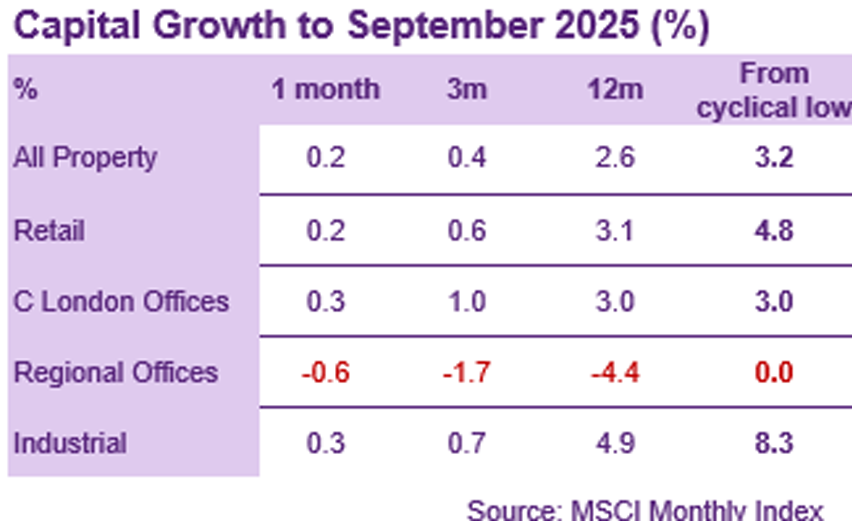
According to MSCI, average commercial property values increased by 0.2% again in August, representing slightly stronger growth than in recent months. On average, capital values have increased by 1.3% so far this year, and by 3.2% from their cyclical low. Nonetheless, values are still, on average, 22.6% below the preceding cyclical peak.
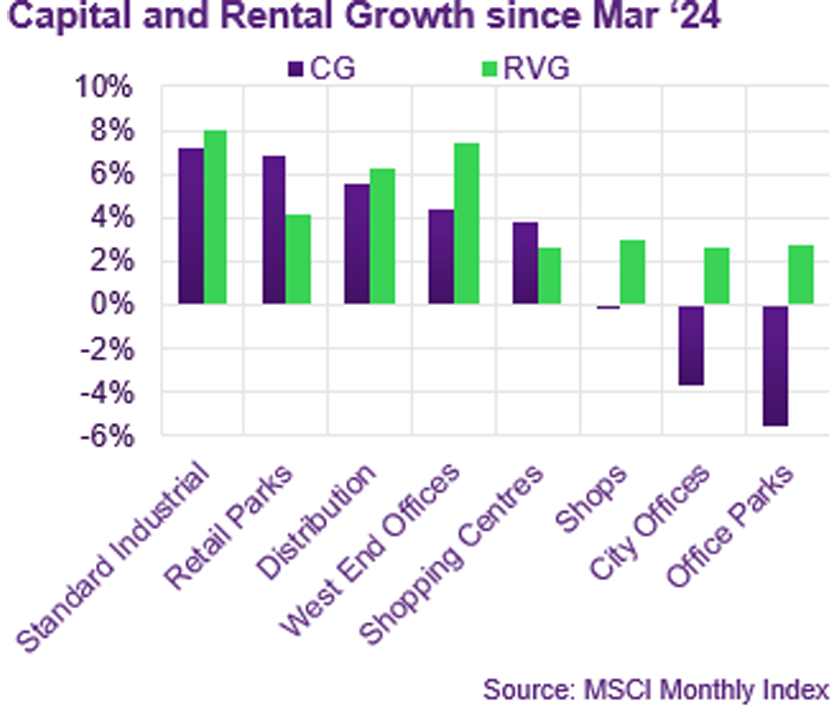
Year-to-date, the London West End office market has delivered the strongest capital growth (4.3%), fully underwritten by robust rental value growth (4.7%). In contrast, offices in outer London have seen values decline by 5.1% YTD, despite modest rental growth (0.6%).
The Industrial sector, which outperformed for much of 2024, is still recording capital growth, but at a much slower rate. Values have risen by 2.5% YTD, backed up by solid rental growth of 3.1%. Standard Industrial continues to outperform with YTD capital growth of 2.8% vs 1.7% for Distribution, and YTD rental growth of 3.2% vs 2.5%.
Retail values have been edging up steadily, with average capital growth of 1.3% so far this year. All formats have delivered moderate levels of growth, supported by similar levels of rental growth. Supermarkets have outperformed from a capital growth perspective (2.2% YTD), despite lagging from a rental value growth perspective (0.9% YTD). |
Investment market activity
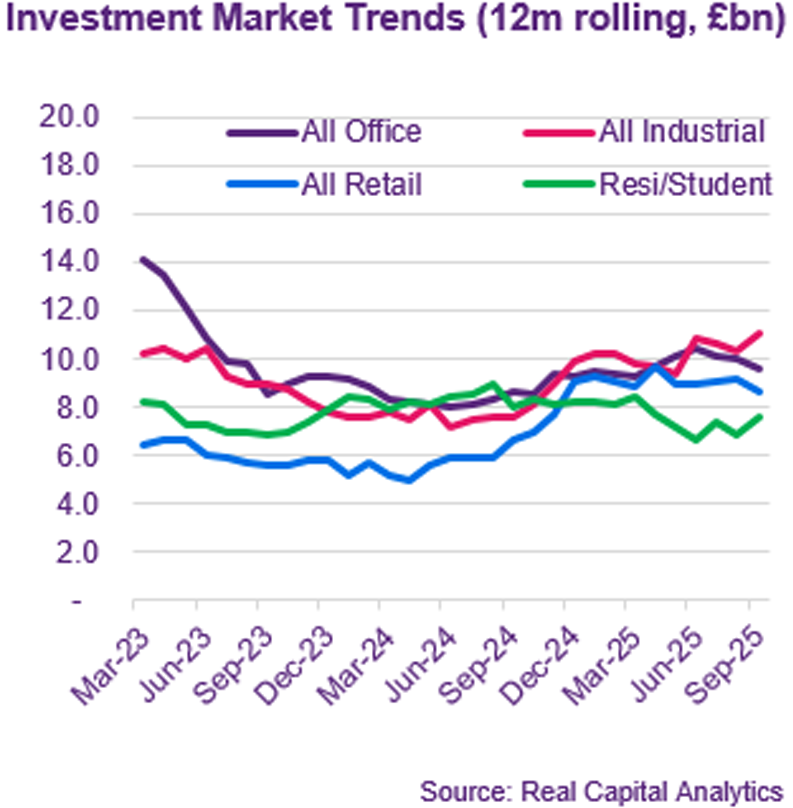
Preliminary data from Real Capital Analytics suggest a pick-up in market activity in September, following a very quiet summer period. £3.2bn completed in the month, a return to levels seen in Spring. The YTD total of £28bn is however still 13% down on the same period last year.
The beds sectors dominated activity in September, led by KKR’s £230m acquisition of a 7-asset portfolio from Curlew Student Trust II. The assets, located in London, Bath, Leeds, Sheffield, Brighton, Coventry and Norwich were built between 2020 and 2022. The portfolio will be managed by KKR’s pan-European platform Inhabeo.
Elsewhere, Watkin Jones sold a 784-bed scheme in Glasgow into their JV with Maslow Capital. The scheme is expected to be ready for the 28/29 academic year and have a gross development value of £182m. In the BTR sector, Greystar acquired a 595-home scheme in East London from Invesco for a reported price of £170m.
Indurent, the logistics platform backed by Blackstone, have committed an estimated £150m to forward purchase an urban logistics portfolio. The portfolio, sold by a JV between Chancerygate and Bridges Fund Management, will comprise 76 units across 3 assets in Birmingham, Leeds and Coventry. The first two are due to complete next year.
Realty Income Corp added to their huge Retail Warehouse holdings, with the £145m acquisition of 4 assets from a JV between Lone Star and Ediston. The purchase price of the assets, located in Scotland and Wales, reflect a net initial yield in the region of 7.5%. |
Market yields
Market expectations for further base rate cuts had been tempered by sticky inflation, with the next cut pushed out until Spring and no further cuts fully priced in. However, hopes of quicker action from the MPC were revived again by the slightly lower than expected inflation numbers for September. At the time of writing, two further cuts are now priced in by April next year.
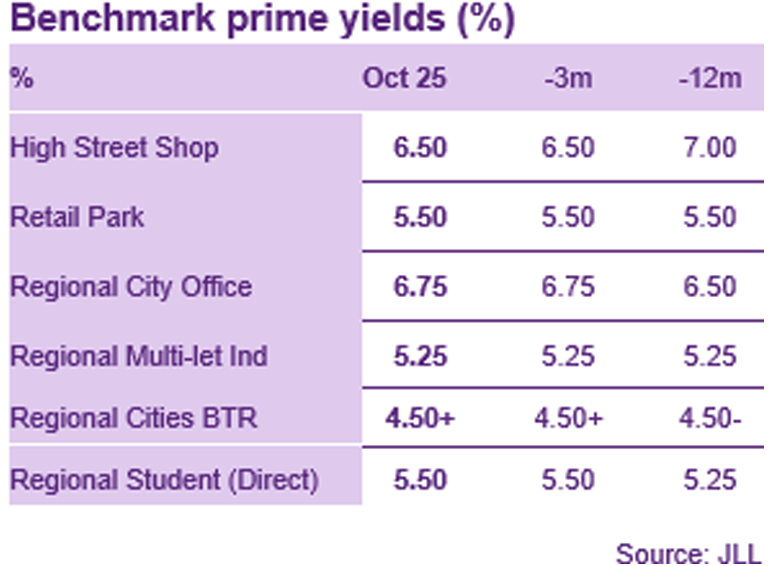
The latest property yield sheet from property adviser JLL, shows very little momentum on yields in either direction. This suggests, depending on your point of view, either that pricing is stable or that buyers and sellers remain someway apart. The truth is somewhere in between. Price discovery is taking place for the best assets, but for many others liquidity remains very thin.
The only benchmarks expected to firm up in the short-term are for Central London offices and hotels, suggesting that, as with most previous investment cycles, the Capital will lead the recovery. Notably it is the larger office lots - >£40m in the City and >£125m in the West End – where yields are expected to harden. This illustrates the broadening out of demand from predominantly private capital to a wider spectrum of institutional buyers.
Gilt yields, which had been pushed out by concerns around inflation and the UK fiscal position, have firmed up again in recent weeks, providing some support to real estate values. The key benchmark, representing the risk-free rate for institutional investors, had been touching 4.8% in early Autumn, but has dropped back below 4.5% at the time of writing. |
Auctions
Allsop’s commercial auction in September contained the highest number of lots of any auction since September 2022. Allsop report a 75% success rate, raising £67m to date, the highest sales proceeds since March 2024. Larger lots have been a notable trend in recent years, with institutions and listed prop co’s increasingly using auctions to shift smaller non-core assets.
Results were mixed for the largest lots however. Of nine lots listed for £2m+, five remained unsold at the time of writing. The highest sale price achieved was £3m, for an office in Bromley with permission for partial residential conversion. Elsewhere, a Halfords in Banbury with 5 years income, and a mixed-use scheme on Eltham High Street sold at yields of 7% and 6.6% respectively. |
Market forecasts
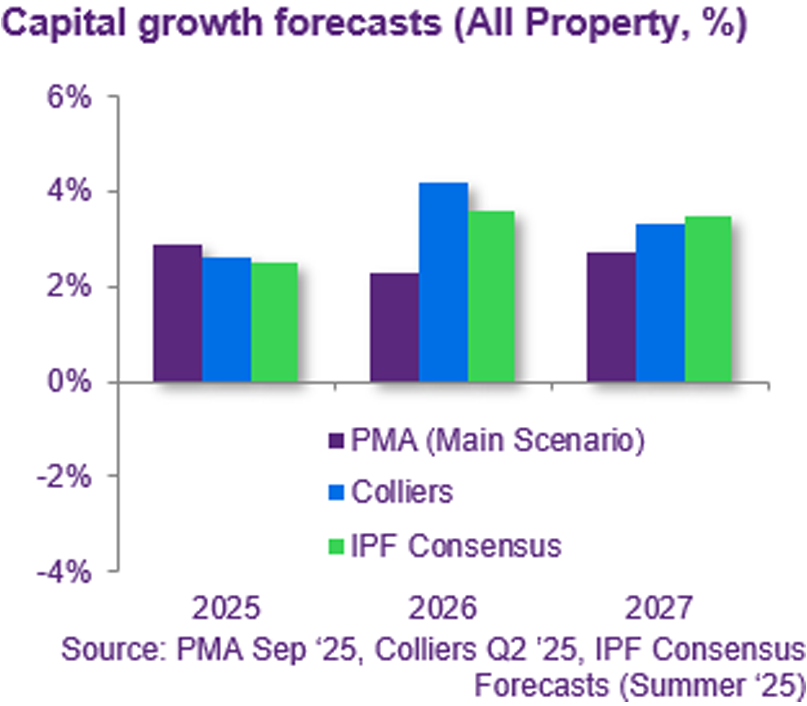
The latest commercial property forecasts published by independent forecaster PMA assume tepid GDP growth this year and next and only a moderate recovery after that. Nonetheless, they expect this will be sufficient to deliver steady rental growth of over 2% per annum, which in turn will support around 10% growth in average asset values over the next five years.
PMA expect Central London offices to outperform the rest of the market, with capital growth of almost 20% over the next five years. This capital appreciation is expected to be fully underwritten by robust rental value growth. The picture in other office markets is more mixed, with moderate rental growth but stagnant asset values on a market average basis.
The Industrial sector is also expected to deliver steady rental and capital growth over a five-year horizon, albeit that the former will be somewhat weaker than has been the case in recent years. Rental growth is expected to run at circa 2% p.a., supporting capital appreciation of circa 13% by 2029.
In the Retail sector, rental growth forecasts are healthiest for Central London and Retail Parks, with 2.7% and 2.2% p.a. respectively. From a capital value perspective most formats are predicted to record some growth, with the notable exception of high streets in smaller towns and secondary shopping centres. |
|
Looking forward
Adjusting for beds under nomination agreements (working on the assumption that they are considered to be 100% let), Unite’s results imply that occupancy across their direct-let portfolio looks to have declined from almost 95% to just below 90%. Given the quality of Unite’s portfolio, such a year-on-year drop would unlikely be an issue particular to them. Indeed, anecdotal evidence suggests that some cities have overall occupancy levels well below 90%.
There are a range of factors that might be feeding into this decline in occupancy levels. The total number of applicants to universities seems to be holding up well, supported by domestic demographics, even if the picture for overseas students is more mixed. However, the share of these applications across different tiers of the higher education sector has become increasingly uneven. Analysis from Knight Frank using UCAS data shows that whilst higher tariff institutions have seen applications rise by 21% since 2019, those at the other end of the spectrum have seen numbers decline by 7% over the same period. Therefore, those weaker institutions are highly likely to be occupying less PBSA than they were, and the surplus won’t always be in the right locations to be absorbed by those institutions that are growing.
This mismatch of supply is the other side of the equation. The market has grown used to a narrative of undersupply of PBSA. However, this is no longer the case across the whole country, with areas of localised oversupply. The picture is muddied further by the “grey” supply available in the rapidly growing Build to Rent (BTR) sector. BTR remains a small part of the overall rental market, but it has more than tripled in size since 2019, and can offer an attractive potential substitute product for PBSA. With a viable alternative increasingly available to students, operators can no longer always rely on scarcity to drive rents ever upwards at a time when affordability is already being tested. |
Visit us
Discover a wealth of
real estate expertise, regardless of your business level or stage.
 |
|
|
If you would like to opt out, please get in touch with your Relationship Manager.
This document has been prepared by National Westminster Bank Plc or an affiliated entity (“NatWest”) exclusively for internal consideration by the recipient (the “Recipient” or “you”) for information purposes only. This document is incomplete without reference to, and should be viewed solely in conjunction with, any oral briefing provided by NatWest. NatWest and its affiliates, connected companies, employees or clients may have an interest in financial instruments of the type described in this document and/or in related financial instruments. Such interests may include dealing in, trading, holding or acting as market-maker in such instruments and may include providing banking, credit and other financial services to any company or issuer of securities or financial instruments referred to herein. NatWest is not and shall not be obliged to update or correct any information contained in this document. This document is provided for discussion purposes only and its content should not be treated as advice of any kind. This document does not constitute an offer or invitation to enter into any engagement or transaction or an offer or invitation for the sale, purchase, exchange or transfer of any securities or a recommendation to enter into any transaction, and is not intended to form the basis of any investment decision. This material does not take into account the particular investment objectives, financial conditions, or needs of individual clients. NatWest will not act and has not acted as your legal, tax, regulatory, accounting or investment adviser; nor does NatWest owe any fiduciary duties to you in connection with this, and/or any related transaction and no reliance may be placed on NatWest for investment advice or recommendations of any sort. Neither this document nor our analyses are, nor purport to be, appraisals or valuations of the assets, securities or business(es) of the Recipient or any transaction counterparty. NatWest makes no representation, warranty, undertaking or assurance of any kind (express or implied) with respect to the adequacy, accuracy, completeness or reasonableness of this document, and disclaims all liability for any use you, your affiliates, connected companies, employees, or your advisers make of it. Any views expressed in this document (including statements or forecasts) constitute the judgment of NatWest as of the date given and are subject to change without notice. NatWest does not undertake to update this document or determine the accuracy or reasonableness of information or assumptions contained herein. NatWest accepts no liability whatsoever for any direct, indirect or consequential losses (in contract, tort or otherwise) arising from the use of this material or reliance on the information contained herein. However, this shall not restrict, exclude or limit any duty or liability to any person under any applicable laws or regulations of any jurisdiction which may not be lawfully disclaimed. The information in this document is confidential and proprietary to NatWest and is intended for use only by you and should not be reproduced, distributed or disclosed (in whole or in part) to any other person without our prior written consent.
National Westminster Bank Plc. Registered in England & Wales No. 929027. Registered Office: 250 Bishopsgate, London EC2M 4AA. National Westminster Bank Plc is authorised by the Prudential Regulation Authority, and regulated by the Financial Conduct Authority and the Prudential Regulation Authority.
|
|
|