If you cannot see the graphic or access the links within this message please go to the source
|
 |
Regional offices left in the shade by emerging recovery
Following the sharp correction in 2022/23, most commercial property sub-sectors have seen values stabilise and then return to modest growth as investors have tentatively re-emerged from hibernation. Industrial and retail warehouses led the way, followed by supermarkets, shopping centres and Central London offices. However, regional offices have largely been left on the sidelines by this nascent market recovery.
Aggregated valuation data from MSCI illustrates this point. Industrial values bottomed out in 2023 and have climbed by an average of 9% since, whilst retail warehouse values started to recover soon after and are now 7.3% off their cyclical low point. Supermarkets, shopping centres and Central London offices took longer to get going but are now up by 3-4% on average. In contrast, average office values outside of Central London have yet to see any recovery at all and are now around 40% lower than they were in mid-2022, at the top of the last cycle.
|
This cumulative decline far exceeds that recorded by other sub-sectors in the current cycle, and is already on a par with the peak-to-trough market decline seen during the Global Financial Crisis. Outside of the GFC, the only instances of value decline of that scale were for London offices following the 80’s/90’s boom and bust, and the evisceration of shopping centre values between 2018 and 2022. The key question for would-be investors - is it a permanent loss of value or merely cyclical?
The first thing to point out is that it is not a clear story of London vs the rest. Indeed, whilst London’s West End market has seen values rebound by 5.4%, the City market is still bumping along the bottom, and Outer London has been one of the worst hit regions of all, with average asset values off by more than 40% since 2022. The second is that the grim picture for capital values has not been mirrored for rents. Whilst office asset values outside the South East have declined by 40% since 2022, rental values have risen by almost 10% on average over the same period. |
|
Commercial property returns
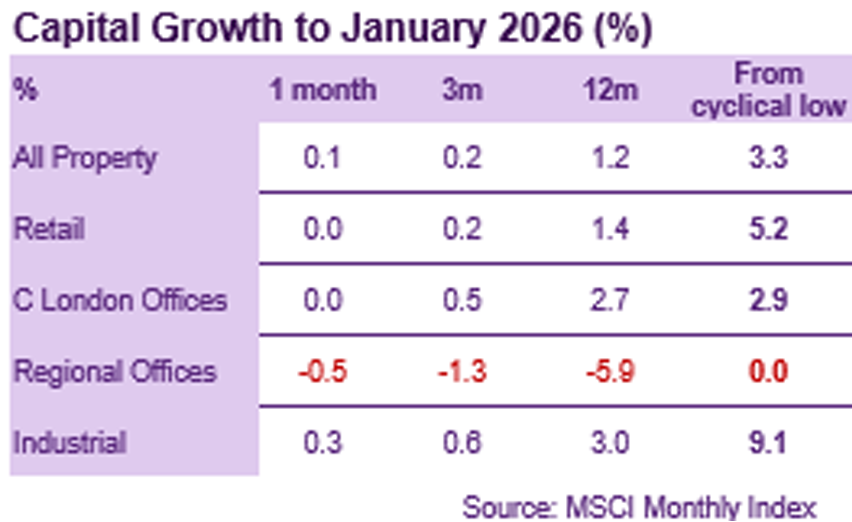
According to MSCI, average commercial property values edged up by 0.1% in the first month of 2026. Although values bottomed out almost two years ago, the pace of growth has felt agonisingly slow for most sub-sectors, with values up by just 1.2% year-on-year and by 3.3% overall.
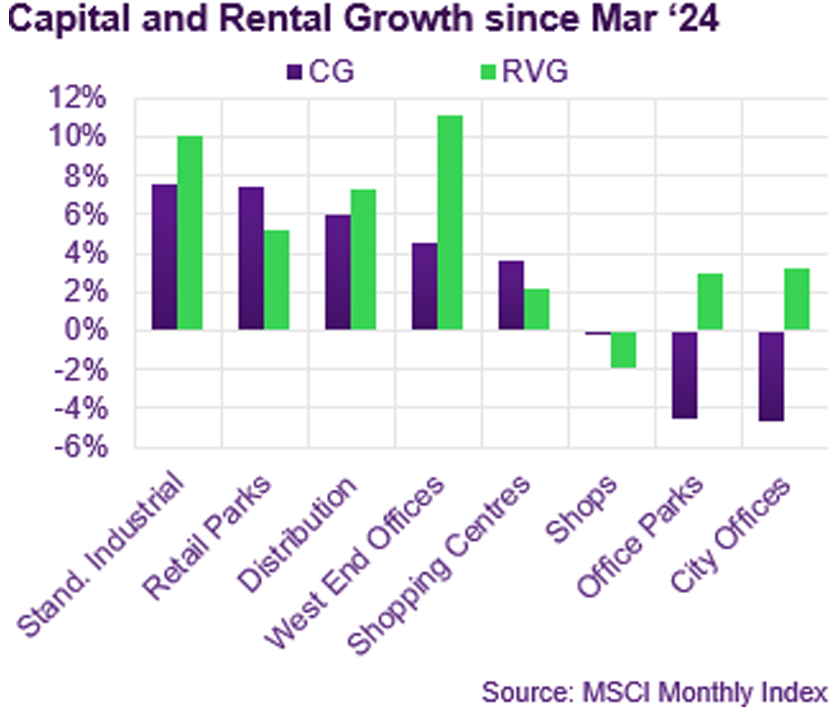
The Industrial sector has been the key driver of growth, and after a soft patch last year, has been leading the pack again in recent months. Asset values are up by average of 9.1% since they bottomed out almost 3 years ago (albeit still 21% below their 2022 peak). This capital value decline is in stark contrast with the 23.6% rental value growth over the same period.
The recovery has been somewhat slower in the Retail sector, but nonetheless asset values have regained 5.2% since they bottomed out in 2024. Retail warehouses have been the strongest performing sub-sector with a cumulative recovery of 7.3% underwritten by 6.8% rental value growth. After a disastrous decade, shopping centres seem to have finally stopped the rot, with values now up by 3.6% since April 2024.
The office sector has underperformed, with the notable exception of London’s West end, where values are up by 5.4% since late-24. Notably West End rental values are up by 8.2% year-on-year and by a striking 20% since mid-22. At the other end of the spectrum, South East office values continue to slide and are down by more than 40% since 2022. |
Investment market activity
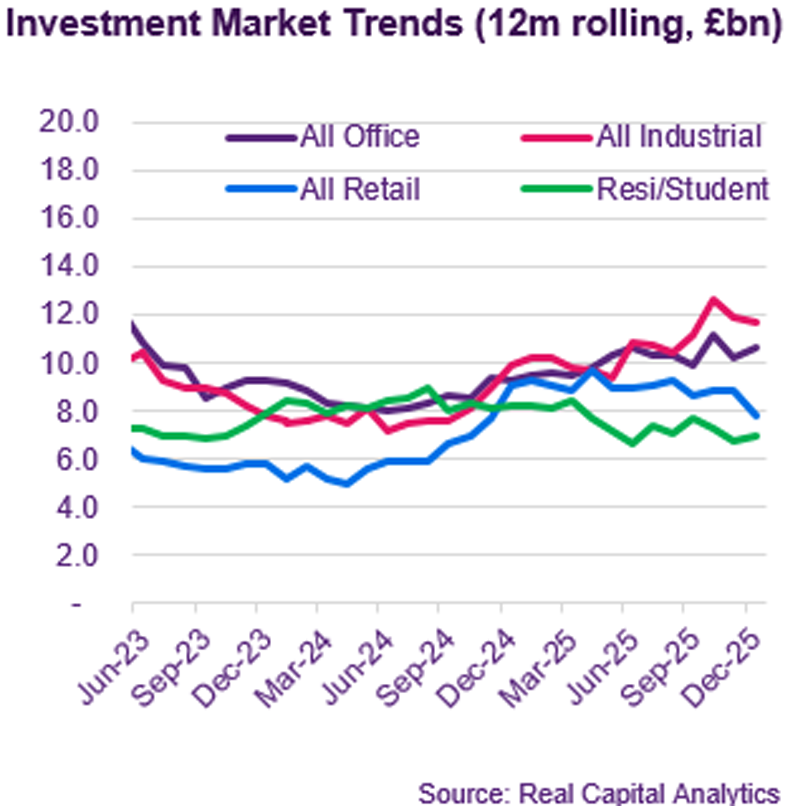
Preliminary data from Real Capital Analytics point to a quiet start to 2026, following on from the surge in activity seen at the very end of 2025. Total investment volume in January was just £1.7bn, 50% down on the £3.3bn completed in the first month of 2025. The final tally for 2025 was £52.5bn, boosted by a Q4 total of £21.4bn, the 3rd highest quarterly total in 10 years.
The two largest dels to close in January involved hotels in Central London. Westmont sold the Westminster London for £290m, ahead of the £275m asking price, making it the largest single-asset hotel sale in 4 years. Elsewhere, Criterion Capital bought the St Giles hotel on Tottenham Court Road with vacant possession for a reported £220m.
Build-to-Rent activity has dropped off over the last year as viability challenges have tightened. Nonetheless, Grainger committed £68.4m in January to forward fund a 195-home scheme in West London. The transaction was completed by Grainger’s JV with Places for London, the property arm of Transport for London.
The largest transaction to complete in the traditional commercial sectors in January was just £28m. A JV between Argo Real Estate and Blue Coast Capital acquired two multi-let estates in Chelmsford and Oxford as part of their plans to build a £500m portfolio.
As the shopping centre market continues to recover, a number of investors have started targeting smaller local centres. One of these, Compagnie des Parcs (CDP), acquired Bligh’s Meadow in Sevenoaks, alongside Revcap, for £26.7m. This reflects a 7% net initial yield off almost full occupancy. |
Market yields
Medium-term swap rates have moved in over the last month as lower inflation and higher unemployment point towards the possibility of looser monetary policy. The benchmark five-year swap has moved in to just below 3.5% at the time of writing, from around 3.75% a month ago. The curve implies the next quarter point cut in April and then one more before the end of the year.
With swaps at this level, and margins having tightened over the last 12 months, the all-in cost of debt starts to offer positive carry for even lower yielding sectors. Gilt yields have also come in slightly, to 4.3% or so, but the risk premium still looks insufficient to support broad-based yield compression.
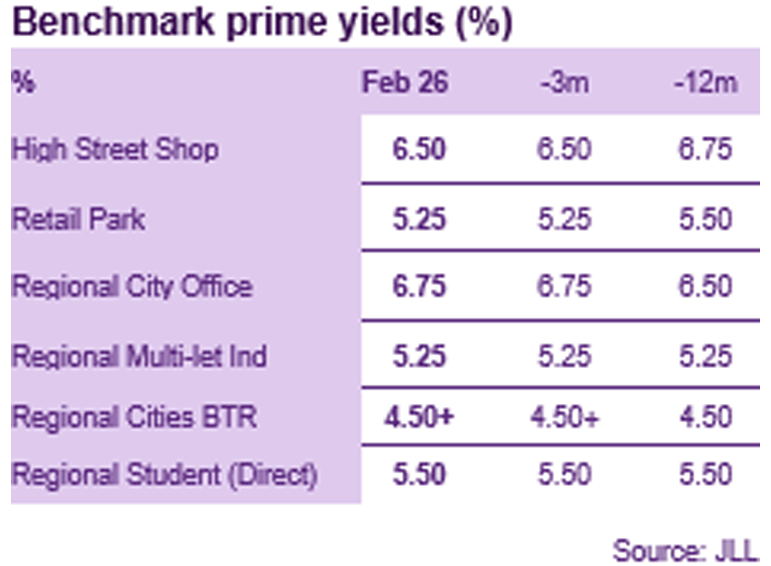
This is reflected in JLL’s latest Monthly Yield Sheet, which shows no movement in any of the 50+ benchmarks monitored in the last month. JLL, expect a handful of sub-sectors, notably shopping centres and parts of the Central London Office market to deliver yield compression over the short-term, but there is as yet no clear transactional evidence to support it.
Equally, there are very few sub-sectors where JLL expect yields to soften. The handful of sub-sectors where JLL perceive the trend as weakening include Life Sciences, Elderly Care, and secondary Retail Parks. |
Auctions
Allsop’s first commercial auction of the year, held on February 11th, raised £40m of sales proceeds through the sale of 52 lots. The total raised is c20% below the equivalent auction last year but reflects an increase from the unusually low total of £37m raised in the last auction of 2025.
Secure income continues to attract the keenest pricing, including a supermarket let to Farm Foods for 10 years (7.0% NIY) and a trade counter asset with a new 10-year lease (6.07% NIY). However, local retail parades with residential above are also in demand for higher yields and diversified income: Maidstone (£2.55m, 9.0% NIY) and Liverpool (£2.8m c10% NIY). |
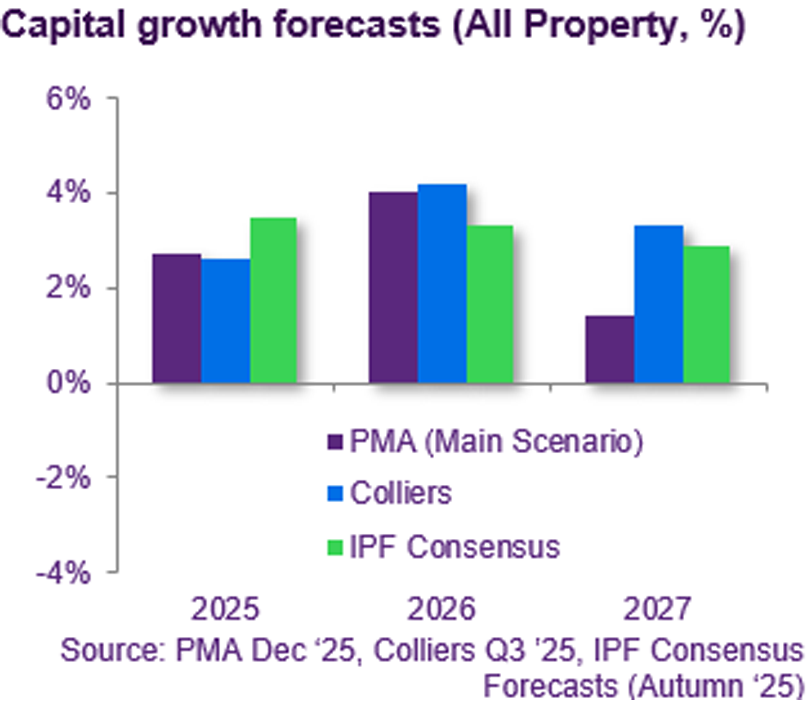
Market forecasts
Real estate adviser Colliers published their latest forecasts in December, predicting faster growth in 2026, following a slightly disappointing 2025. Around mid-year Colliers had, alongside other forecasters, anticipated circa 4% capital growth for 2025, but this tapered off to little more than 1% by year-end. Colliers now predict 3.5% this year, with a further 3.0% in 2027.
Contrary to many other forecasters, Colliers do not expect the Industrial sector to continue its outperformance over the next few years. They anticipate capital growth of 2.5% in 2026 and 3.0% in 2027, just under the market average forecast, despite expecting robust rental growth of 3.2% per annum.
In a turnaround from recent years, Colliers predict that the office sector will deliver the strongest growth over two years, with 3.8% per annum. This capital outperformance would be delivered despite slowing rental growth, from 2.7% last year to 2.5% this year and 2.1% next.
Colliers’ outlook for Retail is for a strong rebound this year, with 4.6% capital growth in 2026, followed by a more moderate 1.8% in 2027. Rental growth is expected to remain relatively steady, with 2.5% this year followed by 1.9% next. |
|
Looking forward
From an occupier market perspective, the picture is remarkably similar across all the key office centres, including Central London. Take-up has recovered from the exceptional lows seen following the pandemic, but remains very uneven within each region. Availability remains relatively high at an aggregate level, but much of this is for older space and/or fringe locations. In contrast, prime availability is very low by historic standards and is unlikely to rise any time soon, as development pipelines remain very constrained. The net result of these dynamics is that prime rents have risen strongly across almost all key office markets. Prime rents have reached record highs in the West End and the City, and the same is true for Manchester, Edinburgh, Birmingham, Leeds, Glasgow and Bristol. Lambert Smith Hampton estimate that prime rents rose by 10.2% across the “Big 6” last year, and by 8.2% across all 15 of the most significant regional markets.
However, all this prime rental growth does not hide the fact that there is undoubtedly a crisis of confidence in the regional office market. Outside of that relatively small subset of the market that can be safely defined as prime, letting activity is slow and investor demand is thin at best. The current situation is a “Catch 22” where asset allocators will not deploy capital towards a sub-sector where there is no confidence in values, and yet valuers can’t be confident in their valuations when there is virtually no market evidence. A key factor in this lack of confidence, from investors and valuers alike, is the uncertainty around how much it will cost to bring older office stock up to modern standards, and whether the end value of such assets justifies the outlay.
Investing in the regional office market today is not one for the faint-hearted. With the exception of prime-located, modern city centre assets there is no clear exit route, which makes investment a leap of faith. However, extreme low liquidity and resulting value dislocation can provide the conditions for acquisitions that look like extraordinarily good value in hindsight. |
Visit us
Discover a wealth of
real estate expertise, regardless of your business level or stage.
 |
|
|
If you would like to opt out, please get in touch with your Relationship Manager.
This document has been prepared by National Westminster Bank Plc or an affiliated entity (“NatWest”) exclusively for internal consideration by the recipient (the “Recipient” or “you”) for information purposes only. This document is incomplete without reference to, and should be viewed solely in conjunction with, any oral briefing provided by NatWest. NatWest and its affiliates, connected companies, employees or clients may have an interest in financial instruments of the type described in this document and/or in related financial instruments. Such interests may include dealing in, trading, holding or acting as market-maker in such instruments and may include providing banking, credit and other financial services to any company or issuer of securities or financial instruments referred to herein. NatWest is not and shall not be obliged to update or correct any information contained in this document. This document is provided for discussion purposes only and its content should not be treated as advice of any kind. This document does not constitute an offer or invitation to enter into any engagement or transaction or an offer or invitation for the sale, purchase, exchange or transfer of any securities or a recommendation to enter into any transaction, and is not intended to form the basis of any investment decision. This material does not take into account the particular investment objectives, financial conditions, or needs of individual clients. NatWest will not act and has not acted as your legal, tax, regulatory, accounting or investment adviser; nor does NatWest owe any fiduciary duties to you in connection with this, and/or any related transaction and no reliance may be placed on NatWest for investment advice or recommendations of any sort. Neither this document nor our analyses are, nor purport to be, appraisals or valuations of the assets, securities or business(es) of the Recipient or any transaction counterparty. NatWest makes no representation, warranty, undertaking or assurance of any kind (express or implied) with respect to the adequacy, accuracy, completeness or reasonableness of this document, and disclaims all liability for any use you, your affiliates, connected companies, employees, or your advisers make of it. Any views expressed in this document (including statements or forecasts) constitute the judgment of NatWest as of the date given and are subject to change without notice. NatWest does not undertake to update this document or determine the accuracy or reasonableness of information or assumptions contained herein. NatWest accepts no liability whatsoever for any direct, indirect or consequential losses (in contract, tort or otherwise) arising from the use of this material or reliance on the information contained herein. However, this shall not restrict, exclude or limit any duty or liability to any person under any applicable laws or regulations of any jurisdiction which may not be lawfully disclaimed. The information in this document is confidential and proprietary to NatWest and is intended for use only by you and should not be reproduced, distributed or disclosed (in whole or in part) to any other person without our prior written consent.
National Westminster Bank Plc. Registered in England & Wales No. 929027. Registered Office: 250 Bishopsgate, London EC2M 4AA. National Westminster Bank Plc is authorised by the Prudential Regulation Authority, and regulated by the Financial Conduct Authority and the Prudential Regulation Authority.
|
|
|