If you cannot see the graphic or access the links within this message please go to the source
|
 |
Yield compression off the agenda as risk free rate climbs
For the second year in a row, early New Year optimism has been quickly stifled by the long reach of Donald Trump. Taking the place of the “Liberation Day” tariffs of early 2025, we have “Operation Epic Fury” in 2026. There’s no way of knowing how the ongoing conflict in Iran will play out, but it is already likely to have a more material impact on the UK property market than the trade “wars” of last year did. Q4 2025 was the third strongest quarter for UK commercial property investment in a decade, yet 2026 had barely got started before the latest crisis exploded.
It was already quite a slow start to the year, with volumes 30% down on the same period in 2025, and it is inevitable that the recent spike in medium-term interest rates will at the very least push back the short-term pipeline. Investors who would have been able to fix their borrowing costs below 4% a few weeks ago, may well now be wishing they had done so, as the anticipation of further base rate cuts have been replaced almost overnight by the fear of renewed hikes.
|
The impact on the risk-free rate has perhaps even wider implications than the cost of debt. The benchmark ten-year Gilt yield broke through 5.0% again in March, having been as low as 4.25% in late February. This means that core investors will typically need to target a total return of 7%+ in order to justify investing in real estate. This may not seem a big ask, given that the latest Investment Property Forum consensus forecasts predict an average total return of 7.7%.
However, this covers a broader risk spectrum of assets, does not take into account transaction costs, and perhaps most importantly was collated before the launch of Operation Epic Fury on the last day of February. We have moved into a different world since then, with sharply higher energy costs, second round inflation impacts, reduced business and consumer confidence and potential fiscal and monetary impacts all conspiring to undermine hopes for the fragile property market recovery. |
|
Commercial property returns
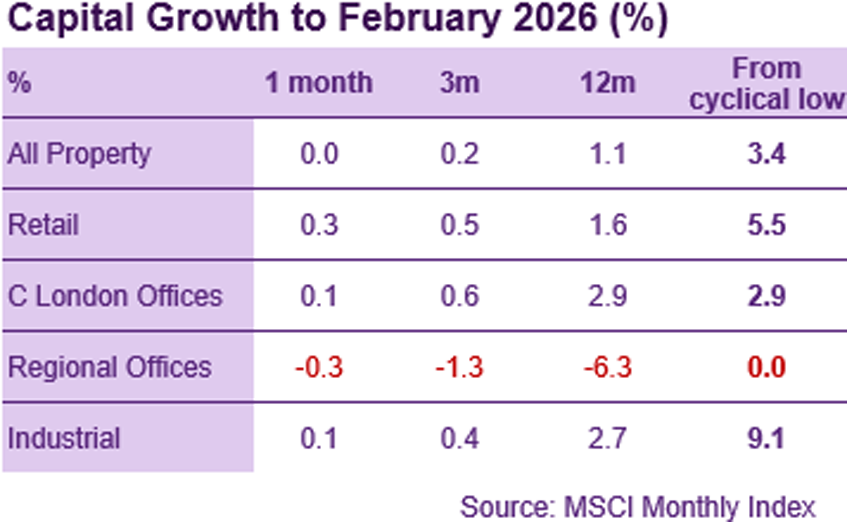
According to MSCI, average commercial property values remained flat in February, and the 3-month trend rate continued to slow, to just 0.2%. On average values have increased by 3.4% since they bottomed out almost two years ago. Rental growth has been slightly more resilient, up by 0.5% over 3 months, but has also slowed in recent months.
Retail has delivered the strongest asset value growth over the last 3 months (+0.5%). This has been driven by Retail Warehouses (+0.7%) and Central London retail (+1.1%). However, Shopping Centres are outperforming from a rental growth perspective (+1.5% over 3 months).
Industrial asset values continue to edge upwards, although 3-month trend growth has slowed to 0.4%, having been three times that rate this time last year. Rental growth remains robust; up 0.9% over 3 months and by 4.7% year-on-year. The strongest rental growth is being recorded by Standard industrial assets in the South East (+1.9% over 3m, +6% year-on-year).
The office sector continues to underperform, with many regions recording declining valuations over the last 3 months: Outer London (-2.3%), Inner South East (-1.4%), Midlands & Wales (-1.1%). However, London’s West End has bucked the trend (+0.9%). Most regions continue to deliver some rental growth albeit the trend rate has slowed. |
Investment market activity
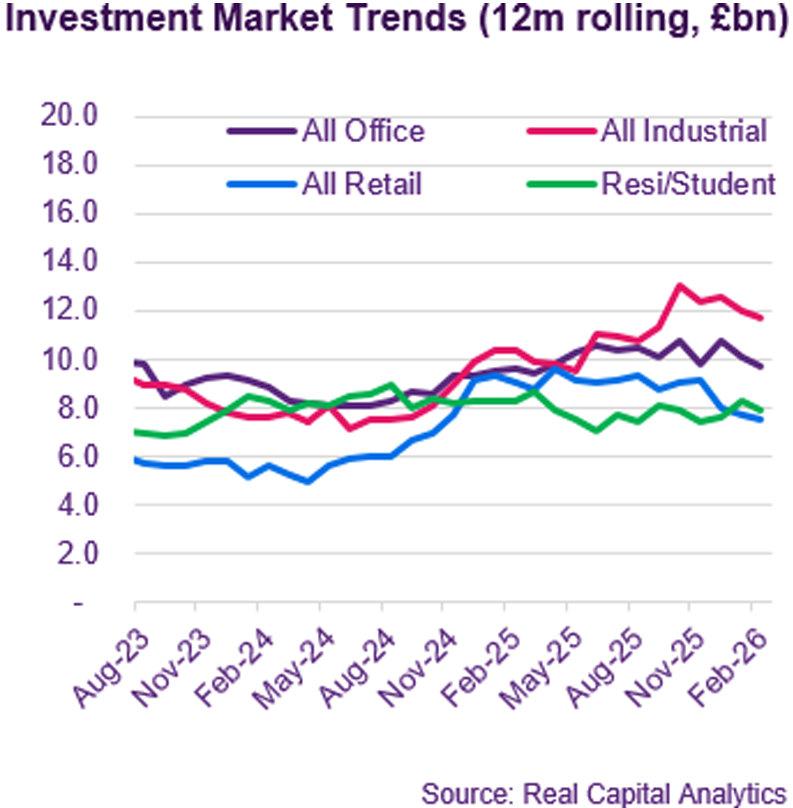
Preliminary data from Real Capital Analytics suggest that the slow start to 2026 continues, with just £1.4bn completing in February (a low total even allowing for just 20 working days). The total across the first two months of the year was £4.25bn, roughly 30% down on last year.
The highest value deal within mainstream sectors was the sale of Team Valley Retail World in Gateshead, one of the largest retail parks in the UK, by a JV between Frogmore and Ares. It is the highest value UK acquisition to date by Israeli investor Ashtrom Properties. The £105m purchase price reflects a yield of 7.5% and a value of circa £277/sq ft.
A second sizeable retail park in Northern England, Monks Cross Shopping Park near York, also changed hands In February. The 35-unit park was sold by a consortium including Legal & General, Schroders, USS and Gingko Tree for a reported £70m (circa £259/ sq ft).
Indurent, the Blackstone-owned platform created from the combination of St Modwen and Industrials REIT, sold almost 1 million square feet of multi-let industrial in February. The 11-asset portfolio was acquired by a JV between Marchmont IM and Invesco for £101.3m (£101/sq ft).
February saw an unusually large office transaction complete outside of the major regional centres. Blue Owl Capital acquired the HQ of St James’s Place Wealth Management in Cirencester for £39m. The 130,000 sq ft campus was developed for the occupier in 2007. The asset was sold by Goldmoney, a Canadian precious metals trading company, which acquired the asset from Aberdeen in 2023 for £26.5m.
|
Market yields
The conflict in the Middle East has driven up medium-term interest rates as markets factor in higher inflation expectations. Five-year swaps have jumped about 75bp month-on-month, hitting 4.25% at the time of writing. The benchmark ten-year Gilt yield has also risen sharply, recently breaching 5%. Prospects for yield compression have therefore receded, and if rates were to stay at this level for a prolonged period (or increase further), property yields would inevitably come under upward pressure.
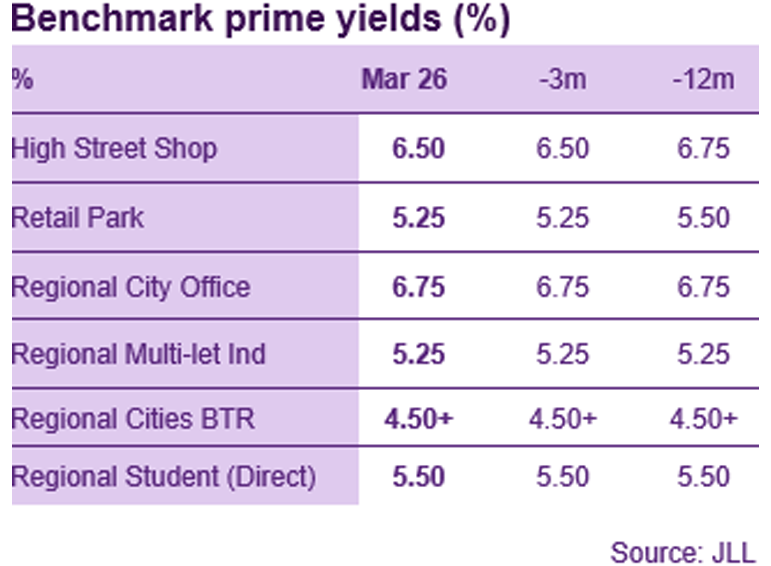
JLL’s Monthly yield sheet for March shows no movement in either direction month-on-month, although it is notable that the sheet was collated on the 2nd of March, at a time when the 5-year swap was at 3.6% and the 10-year Gilt at 4.4%. At the time markets were still expecting another base rate cut, a hope which has evaporated, for now at least.
The only change of any kind noted in JLL’s March sheet was that the secondary retail park benchmark has stabilised at 7.0%, having previously been thought to be under upward pressure. This benchmark is perhaps more reflective of prime but restricted parks rather than genuinely secondary parks. |
Auctions
Allsop’s commercial auction in March achieved £58m in sales, comfortably ahead of the same auction last year, and the second highest total raised since December 2024. This success comes despite 24 of 119 lots being withdrawn ahead of the auction, perhaps reflecting vendors’ nervousness about timing. Of the remaining lots, 70 were sold, reflecting a moderate success rate of 73%.
The highest price achieved was for a Tesco supermarket in Lymington, with 6 years unexpired and two flats above, which sold for £2.59m (7.6% yield). Other notable sales included: a retail parade with flats above in East Sussex (£2.25m, 8.4%); a grade II listed industrial estate in Deeside (£2m, 13.5%); a Travelodge in Macclesfield with 18 years of RPI-linked income (£1.65m, 8.2%). |
Market forecasts
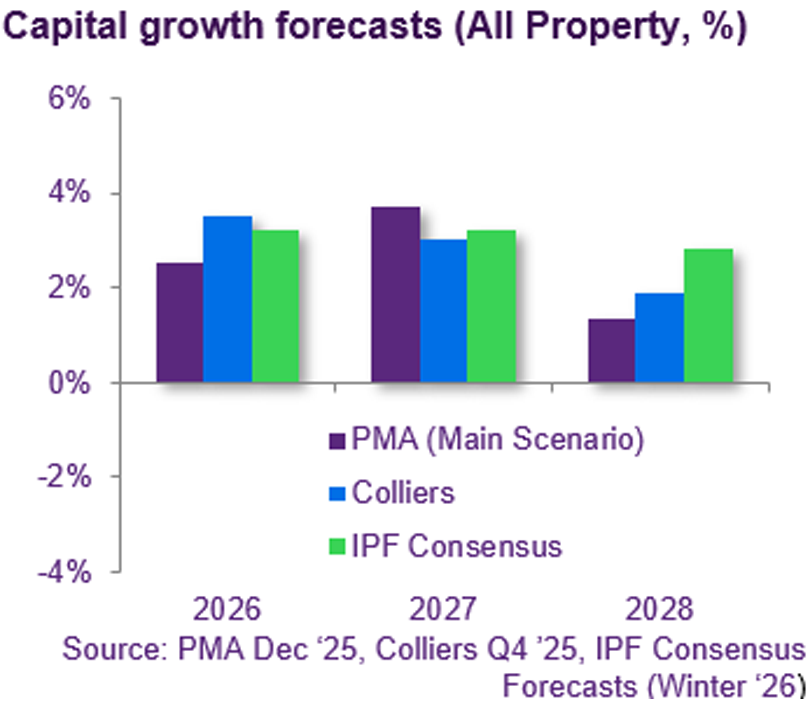
The latest consensus forecasts published by the IPF show a remarkably benign outlook for the commercial property market, although it should be noted that the component predictions were collected between mid-January and late-February just before the current conflict in Iran started.
The consensus at the time was for average capital values to grow by 2.8% per annum over the next five years, almost entirely underwritten by rental value growth of 2.7% p.a. Capital growth was expected to be very steady, strongest in 26/27 at 3.2% p.a., only slowing slightly to 2.5% by 2030. Rental value growth was predicted to be even more consistent, in a narrow range of 2.6% to 2.8%.
Central London offices were expected to deliver the strongest capital growth this year (4-5%), delivering c3% per annum over 5 years. Industrial was anticipated to deliver the steadiest growth over 5 years at 3.2% p.a. Both sectors were expected to record around 3% per annum rental growth.
The Retail sector was expected to deliver the strongest total returns, notably Shopping Centres (8.5% p.a.) and Retail Warehouses (8.2% p.a.). In both cases the return would be largely delivered by income, with rental and capital growth expected to be relatively moderate at 1-2% per annum. |
Looking forward
Previous cyclical recoveries have become turbo-charged at the point when property yields start to compress due to a virtuous combination of lower interest rates, rebased occupier markets and renewed confidence from investors. The current cycle had already benefited from lower rates, and the occupier market was proving to be reassuringly stable. As a result, there were emerging signs of investor confidence returning at the back end of 2025. However, the current crisis has all but removed the hope of lower rates and instead re-introduced the threat of renewed hikes. The impact on occupier markets will be less immediately visible, but they will inevitably suffer if the conflict is prolonged. In the short-term any hope of widespread yield compression to boost returns has evaporated.
Clearly, it’s a fast-moving situation, and since the time of writing it’s possible that hopes of a resolution have increased once again. Fears of higher interest rates could subside quickly if the Straits of Hormuz are re-opened and oil starts to flow round the global economy once more. However, even in this scenario, Central Banks would remain more wary of inflation than they were a month ago, and the cost of hedging interest rate risk would likely remain elevated. This scenario would however, help to limit the impact on occupier markets, with plans for business investment maybe escaping too much permanent damage. Under such a scenario, the IPF consensus forecasts of 6.5-8.5% total return could still be plausible, given they were never predicated on yield compression and only assumed moderate levels of rental growth. However, even under this more optimistic scenario, the upside risk of the kind of cyclical upswings seen in 1993 and 2010 has most probably disappeared. On balance of probabilities, property yields are now more likely to move out than come in, and rental growth may be slightly weaker than hoped. Therefore, for core investors, property sectors offering a relatively high but stable income return may now be a more defensive proposition than those with keener yields predicated on market-beating income growth. |
Visit us
Discover a wealth of
real estate expertise, regardless of your business level or stage.
 |
|
|
If you would like to opt out, please get in touch with your Relationship Manager.
The Royal Bank of Scotland plc, The Royal Bank of Scotland N.V, or an affiliated entity (‘RBS’) and for the purposes of Directive 2004/39/EC has not been prepared in accordance with the legal and regulatory requirements to promote the independence of research. Regulatory restrictions on RBS dealing in any financial instruments mentioned at any time before this document is distributed to you do not apply. This document has been prepared for information purposes only. It shall not be construed as, and does not form part of an offer, nor invitation to offer, nor a solicitation or recommendation to enter into any transaction or an offer to sell or a solicitation to buy any security or other financial instrument. No representation, warranty or assurance of any kind, express or implied, is made as to the accuracy or completeness of the information contained herein and RBS and each of their respective affiliates disclaim all liability for any use you or any other party may make of the contents of this document. The contents of this document are subject to change without notice and RBS does not accept any obligation to any recipient to update or correct any such information. Views expressed herein are not intended to be and should not be viewed as advice or as a recommendation. RBS makes no representation and gives no advice in respect of any tax, legal or accounting matters in any applicable jurisdiction. This document is not intended for distribution to, or use by any person or entity in any jurisdiction or country where such distribution or use would be contrary to local law or regulation. The information contained herein is proprietary to RBS and is being provided to selected recipients and may not be given (in whole or in part) or otherwise distributed to any other third party without the prior written consent of RBS. RBS and its respective affiliates, connected companies, employees or clients may have an interest in financial instruments of the type described in this document and/or in related financial instruments. Such interest may include dealing in, trading, holding or acting as market-makers in such instruments and may include providing banking, credit and other financial services to any company or issuer of securities or financial instruments referred to herein. The Royal Bank of Scotland plc. Registered in Scotland No. 90312. Registered Office: 36 St Andrew Square, Edinburgh EH2 2YB. The Royal Bank of Scotland plc is authorised by the Prudential Regulation Authority and regulated by the Financial Conduct Authority and Prudential Regulation Authority. The Royal Bank of Scotland N.V., established in Amsterdam, The Netherlands. Registered with the Chamber of Commerce in The Netherlands, No. 33002587. Authorised by De Nederlandsche Bank N.V. and regulated by the Authority for the Financial Markets in The Netherlands. Agency agreements exist between different members of The Royal Bank of Scotland Group plc.
© Copyright 2026 The Royal Bank of Scotland plc. All rights, save as expressly granted, are reserved. This communication is for the use of intended recipients only and the contents may not be reproduced, redistributed, or copied in whole or in part for any purpose without The Royal Bank of Scotland plc’s prior express consent.
|
|
|