If you cannot see the graphic or access the links within this message please go to the source
|
 |
Inflation to exacerbate divergence between rents and values
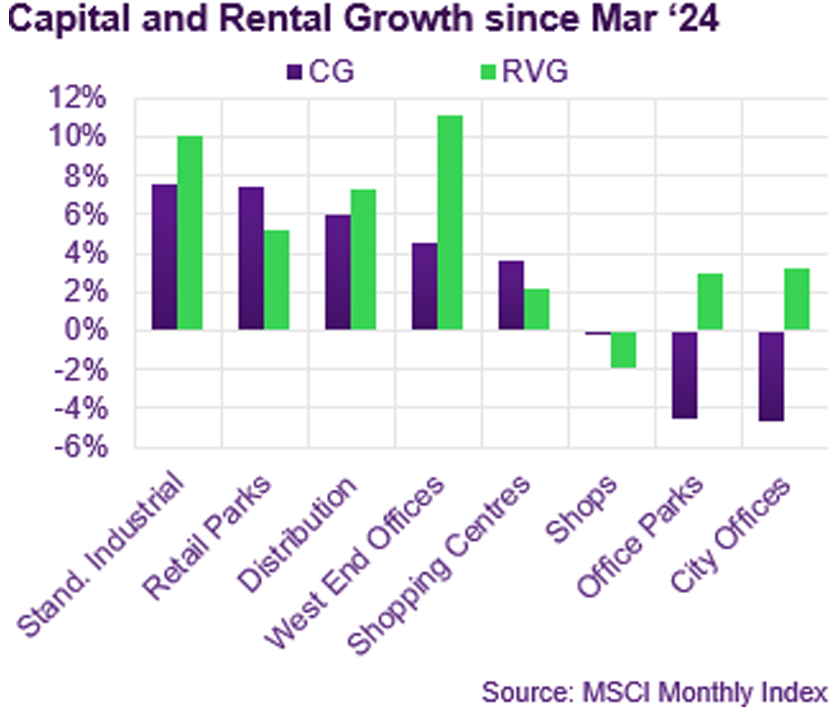
The latest phase of this hesitant recovery has been characterised by a twin track property market, with rental values rising across most sectors, whilst asset values have been drifting sideways. This has largely been a function of trends in inflation and interest rates, with the former having generally been higher than desired and the latter therefore coming down more gradually than expected.
Elevated inflation in the economy has to some extent fed through into rental growth, in nominal terms at least, yet has also resulted in tighter monetary conditions, which have in turn have born down on asset values.
There has also been another factor involved - the lack of any sustained development boom through the last cycle. The real estate cycle was interrupted at regular intervals; by the EU referendum, Brexit itself, the global pandemic and then war in Ukraine followed by a dramatic rise in interest rates. As a result, the stock of modern space has gradually declined across large parts of the market. |
This shortage of newbuild stock has led to an extremely competitive market for what has been delivered. Developers have targeted high rents to justify elevated build costs, and occupiers have had little choice but to pay them given the lack of alternatives. This scarcity premium has subsequently trickled down to well-located second-hand or refurbished stock which has been the substitute for those unwilling or unable to pay top rents for newbuild.
However, with rental growth driven by scarcity rather than rising aggregate demand, this is not a rising tide that has floated all boats. There is no scarcity of secondary stock in most markets and therefore no pricing tension. When these assets are also in out-of-favour locations, exit values typically won’t justify the elevated cost of refurbishing the space. If current geopolitical events trigger more inflation, all the above trends are going to be exacerbated, with higher build costs and uncertain exit values leading to less new space and still higher prime rents. In contrast, it will become even less viable for those with weaker assets to refurbish their way out of trouble. |
|
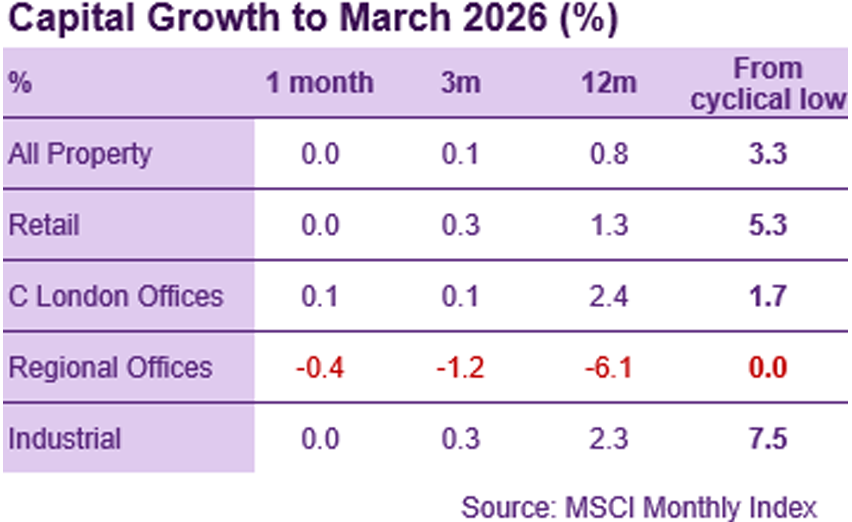
Commercial property returns
According to MSCI, the uneven recovery in commercial property values completely ground to a halt in March. In fact, on a market average basis values have drifted sideways for the last six months. This stagnation in capital values has come despite a 1.5% increase in average rental values over the same six-month period.
The Industrial sector has delivered the most meaningful recovery so far, with asset values up by 7.5% since the low point in 2023. However, the rate of growth has slowed significantly in recent months. The 3-month trend rate has dropped to just 0.3%, from 1.0% a year ago. This slower rate of capital appreciation is fully underwritten by rental value growth.
The Retail sector has delivered moderate but relatively steady asset value growth over the last year. Current 3-month trend growth matches the Industrial sector (0.3%) and is also well supported by rental appreciation. The various formats have moved broadly in-line, although shopping centre value growth seems to have stalled in recent months.
Much of the office sector is yet to see any value recovery at all, with some regions still recording significant declines. Office values in Outer London for example dropped by 2.3% over the first quarter of ’26 and have almost halved since mid ‘22. In contrast, London West End values have rebounded by 5.8% since their 2024 low. |
Investment market activity
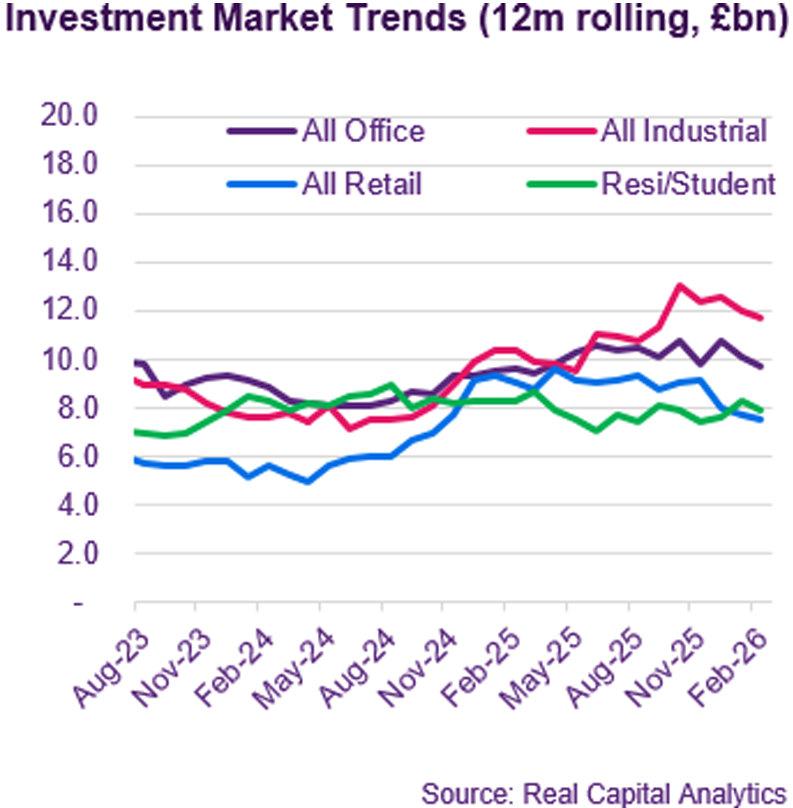
Preliminary data from Real Capital Analytics (RCA) suggest that the investment market picked up slightly in March, despite the impact from geopolitical events. £4.1bn completed in the month, materially up from a very quiet February (£2bn). Nonetheless, the Q1 total of £9.2bn was slightly down on 2025, making it the weakest quarter since Q3 ‘23.
The largest deal to complete in March was the £500m commitment by a JV between Kennedy Wilson and CPPIB to acquire 788 new homes for their single-family housing platform. The houses are being acquired from six different housebuilders across 10 separate sites. The transaction takes the platform pipeline to 2,000 homes, with 300 completed to date.
March also saw a very significant shopping centre deal, with the purchase of Merry Hill by Redical for £280m. The centre, the 9th largest in the UK with over 200 units, was formerly owned by Intu, but has been controlled by a group of lenders since the REIT collapsed in 2020. Redical have previously acquired the Liberty in Romford and Victoria Quarter in Leeds.
A JV between Chancerygate and GIC completed the largest industrial deal of the year so far, with the purchase of the World Freight Centre at Manchester Airport for £155m. They plan to develop a 150,000 sq ft logistics facility on part of the 54-acre site sold by Columbia Threadneedle.
A prominent office building in Edinburgh, Waverley Gate, was acquired by Melford Capital for a reported £78m. The sale price is almost exactly what vendors Kennedy Wilson paid for the asset in 2022. According to RCA, the price reflects a yield of 8.5% compared to 5.7% at the time of the last trade. |
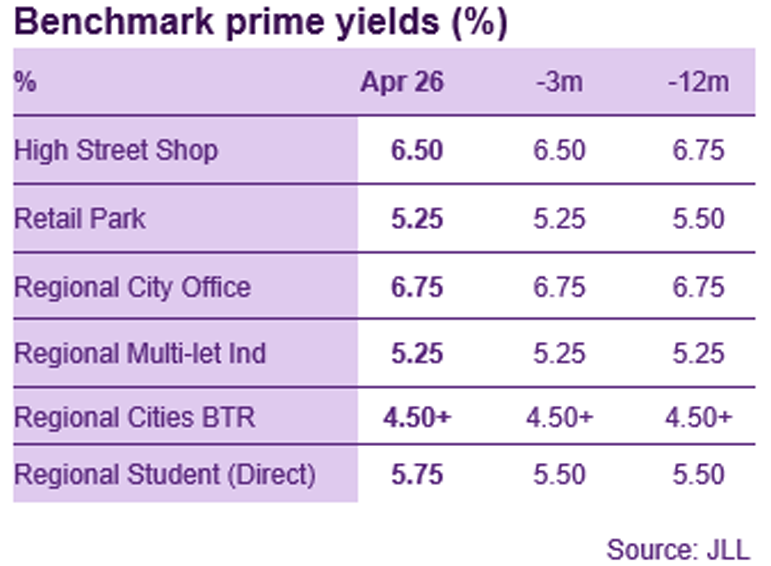
Market yields
Medium-term interest rates eased slightly through mid-April, with markets now pricing in just one 25bp rate hike this year, compared to 2 or 3 previously. However, this contrasts with prior expectations of further base rate cuts. The benchmark ten-year Gilt yield remains elevated (4.9% at time of writing) circa 50bp above range in the months immediately preceding the conflict.
The only impact so far on property yields, according to JLL’s monthly yield sheet, is that student accommodation benchmarks have moved out, although these have also been impacted by sector-specific concerns over softer occupancy rates. JLL perceive that prime regional benchmarks for direct let assets have moved out by 25bp as have all leased PBSA benchmarks.
The broader impact from higher medium-term rates is that any hopes for widespread yield compression this year have seemingly evaporated. Some retail benchmarks, which had been expected to harden, are now seen as being stable at current levels. Only a few select Central London office benchmarks are still showing as trending stringer although transactional evidence has been thin on the ground in recent months.
|
Auctions
Data collected by the Essential Information Group (EIG) shows that the commercial auction market has been active this year, with a 19% increase in the number of lots listed and a 17% increase in the number of sales. The slightly reduced success rate of c68%, and a 10% lower average sales prices perhaps reflect a degree of caution amongst buyers despite the higher volumes.
The Acuitus auction in March raised £18.9m, including the sale of two local shopping centres. The Arcade in Bedford, sold for £2.6m, reflecting a gross yield of circa 16%. In Cirencester, the Bishops Walk shopping centre sold prior to auction at a price “well in excess” of the £3.1m asking price, which would have represented a gross yield of 13.7%. |
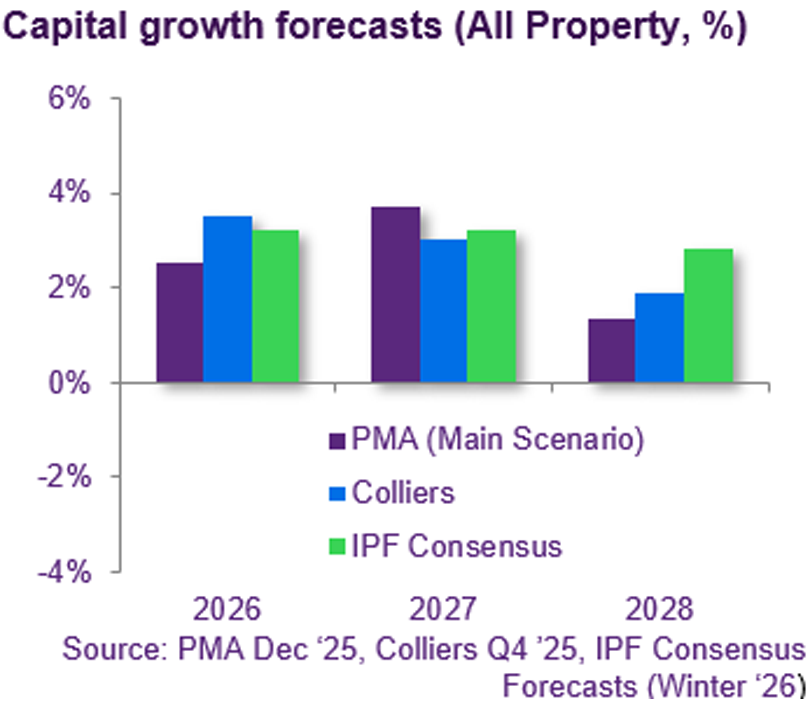
Market forecasts
The latest forecasts from leading independent forecaster PMA, published in March, predicted a broad continuation of the slow and uneven recovery, but with London now expected to materially outperform. In contrast, average values for regional offices and some retail sub-sectors are expected to drift downwards throughout the forecast horizon.
Central London offices are predicted to deliver the strongest capital growth over the next three years, with City values rising by c18% and West End values by circa c11%. This growth is expected to be driven almost entirely by rental growth. In stark contrast, M25 West office values are expected to slide by almost 8% over 3 years, despite a continuation of modest rental growth.
Expectations for the Retail sector are extremely mixed, with Central London retail values expected to rise by c14% over 3 years, whilst small town shop values are expected to fall by around 6% over the same period. Retail parks are expected to deliver steady growth (c7% over 3 years), whilst shopping centre forecasts are split between the largest (+1%) and the rest (-5%).
Value growth in the Industrial sector is expected to be moderate (+5% over 3 years) and well supported by rental growth. Growth is expected to be slightly stronger for multi-let than distribution, with London expected to outperform. |
|
Looking forward
There is no way of knowing how the current situation in the Middle East will play out. Indeed, sentiment may well have swung again since the time of writing. However, we have probably already passed the point where a negative economic impact could be entirely avoided even if a resolution were to be arrived at quickly. The impact of higher oil prices, interrupted supply chains and elevated interest rate risk are already baked in to some extent. The price of fixing build costs or hedging rates has already increased materially, and a significant pipeline of transactions will have stalled or even collapsed as investors seek to navigate heightened uncertainty.
Some impact on property valuations is likely to be felt quite quickly. The risk-free rate is currently about 50bp above its pre-crisis range, and investors are also likely to demand higher risk premia for all but the safest assets. The impact of this yield rerating will be mitigated for the strongest assets as income growth and rental value appreciation may be sufficient to deliver the extra yield required without hitting capital values. Of course, current positive rental trends may not continue, but the impact on occupier demand will be slower to come through and may not come through at all unless the crisis deepens or persists for a significantly extended period.
How investors position themselves will depend on their investment horizon and appetite for risk. The current outlook for inflation and interest rates is pushing out property yields and reducing the value applied to future income growth, whilst at the same time arguably increasing the likelihood of that growth (for good quality assets at least). Investors with a medium-term investment horizon and a moderate tolerance for risk may well see this as an attractive entry point with competition likely to be reduced, whilst acknowledging that asset valuations may well get worse before they get better. |
Visit us
Discover a wealth of
real estate expertise, regardless of your business level or stage.
 |
|
|
If you would like to opt out, please get in touch with your Relationship Manager.
This document has been prepared by National Westminster Bank Plc or an affiliated entity (“NatWest”) exclusively for internal consideration by the recipient (the “Recipient” or “you”) for information purposes only. This document is incomplete without reference to, and should be viewed solely in conjunction with, any oral briefing provided by NatWest. NatWest and its affiliates, connected companies, employees or clients may have an interest in financial instruments of the type described in this document and/or in related financial instruments. Such interests may include dealing in, trading, holding or acting as market-maker in such instruments and may include providing banking, credit and other financial services to any company or issuer of securities or financial instruments referred to herein. NatWest is not and shall not be obliged to update or correct any information contained in this document. This document is provided for discussion purposes only and its content should not be treated as advice of any kind. This document does not constitute an offer or invitation to enter into any engagement or transaction or an offer or invitation for the sale, purchase, exchange or transfer of any securities or a recommendation to enter into any transaction, and is not intended to form the basis of any investment decision. This material does not take into account the particular investment objectives, financial conditions, or needs of individual clients. NatWest will not act and has not acted as your legal, tax, regulatory, accounting or investment adviser; nor does NatWest owe any fiduciary duties to you in connection with this, and/or any related transaction and no reliance may be placed on NatWest for investment advice or recommendations of any sort. Neither this document nor our analyses are, nor purport to be, appraisals or valuations of the assets, securities or business(es) of the Recipient or any transaction counterparty. NatWest makes no representation, warranty, undertaking or assurance of any kind (express or implied) with respect to the adequacy, accuracy, completeness or reasonableness of this document, and disclaims all liability for any use you, your affiliates, connected companies, employees, or your advisers make of it. Any views expressed in this document (including statements or forecasts) constitute the judgment of NatWest as of the date given and are subject to change without notice. NatWest does not undertake to update this document or determine the accuracy or reasonableness of information or assumptions contained herein. NatWest accepts no liability whatsoever for any direct, indirect or consequential losses (in contract, tort or otherwise) arising from the use of this material or reliance on the information contained herein. However, this shall not restrict, exclude or limit any duty or liability to any person under any applicable laws or regulations of any jurisdiction which may not be lawfully disclaimed. The information in this document is confidential and proprietary to NatWest and is intended for use only by you and should not be reproduced, distributed or disclosed (in whole or in part) to any other person without our prior written consent.
National Westminster Bank Plc. Registered in England & Wales No. 929027. Registered Office: 250 Bishopsgate, London EC2M 4AA. National Westminster Bank Plc is authorised by the Prudential Regulation Authority, and regulated by the Financial Conduct Authority and the Prudential Regulation Authority.
|
|
|