If you cannot see the graphic or access the links within this message please go to the source
|
 |
How Retail can be defensive despite cost-of-living perma-crisis
Even a casual reader of UK newspapers in recent years will have become very familiar with the phrase “cost of living crisis”. One left-leaning national daily even maintains an entire section dedicated to the concept. This phrase has become so embedded that even three years of positive real earnings growth (c7% cumulatively) has seemingly not reduced the perception of crisis.
This is reflected in consumer sentiment surveys, which although improved since the nadir of 2022 remain firmly negative. This general gloom has not been helped by the more visible type of crisis playing out in the Middle East, which has led to a renewed increase in inflation and a spike in medium-term interest rates.
Against this backdrop why would anyone want to invest in Retail property? The sector has lost so much value for investors in recent decades that it has almost become a byword for underperformance.
However, there are significant factors that support a premise that Retail could in fact prove to be relatively resilient against the backdrop of potentially higher inflation and rates. |
The first, and most incontrovertible, of these is simply that initial yields on offer in the Retail sector are materially higher than those for similar quality assets in more favoured sectors.
Higher yields can offer significant protection against rising rates, as seen in 2022/23. Of course, Retail yields are higher for a reason, with investors applying a higher risk premium to day one cashflows in the expectation that they might well decline through their hold period.
However, at a sector average level this has in fact not been the case for some time, with vacancy rates coming down across much of the sector, and sporadic rental uplifts starting to feed through to moderate income growth for stronger sub-sectors like Retail Warehousing.
As a result, running yields are now stable or even gradually growing, potentially providing the bedrock of a very healthy total return. In a world where economic growth is expected to be sluggish, and medium-term rates are likely to be volatile, a solid slug of steady income and valuations that are less sensitive to interest rates are attributes that are likely to serve the sector well. |
|
Commercial property returns
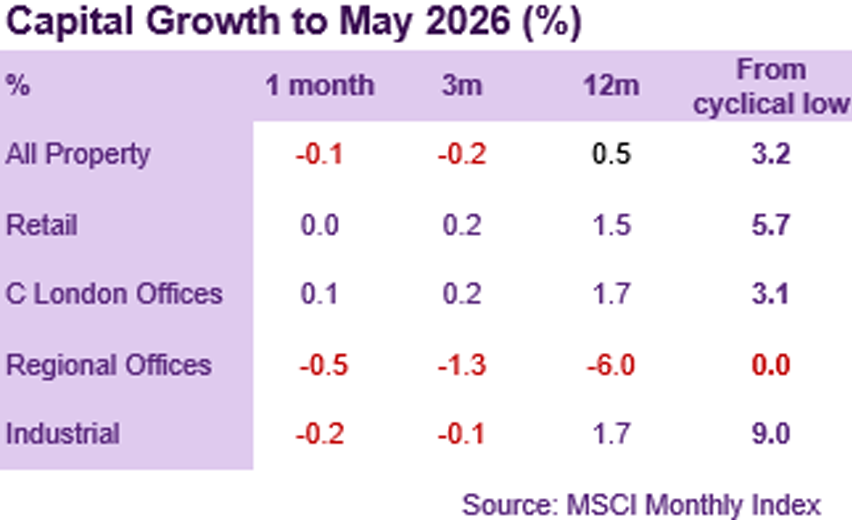
According to MSCI, the stuttering recovery in commercial property values has now seemingly ground to a complete halt. On a market average basis, values have gone nowhere for the last six months. This stagnation in capital values has come despite rental values continuing to edge upwards over the same six-month period (+1.2%).
The Industrial sector set the initial pace of recovery in 2024/25, and asset values are up by 9.0% since the low point in 2023. However, the rate of growth has slowed significantly this year. In fact, the 3-month trend rate turned negative in May (-0.1%). However, rental values continue to rise at a robust rate, up by 0.9% over 3 months and by 4.4% year-on-year.
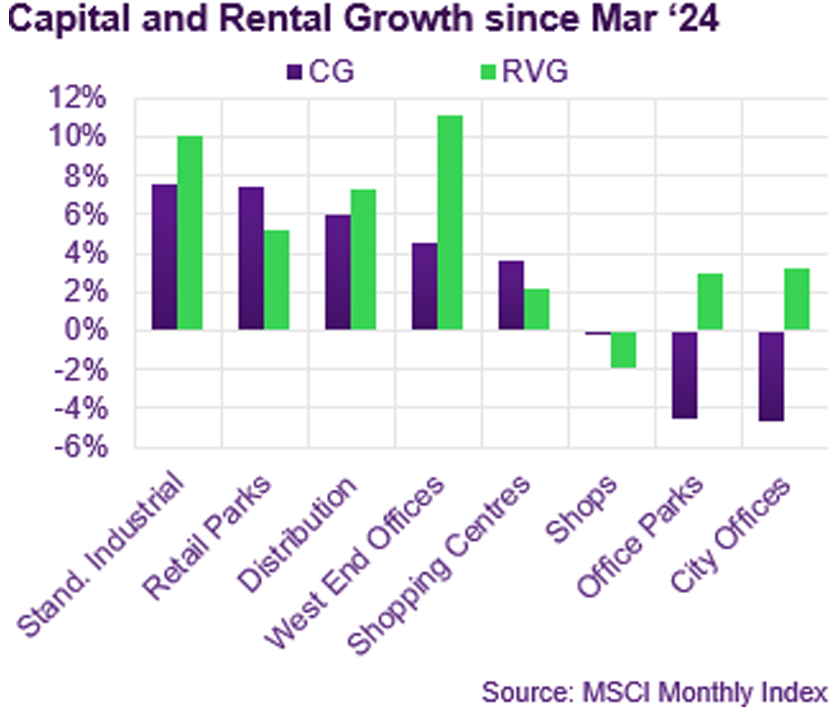
The Retail sector has in contrast delivered a slow but fairly steady rate of recovery, albeit this varies by format. Retail Warehouse values have made the strongest recovery to date, up by 8.0% since 2024, underwritten by rental value growth of 7.5% over the same period. The recovery for shops and shopping centres has been more marginal at circa 3.0%.
In the office sector, London West End has outperformed significantly, with capital values up by 5.9% since September ’24, driven by a dramatic 21% rise in rental values over the same period. In contrast, most other regions are yet to see any recovery. Outer London values are now 48% below Jun ’22 levels, compared to a shortfall of just 13% in the west End. |
Investment market activity
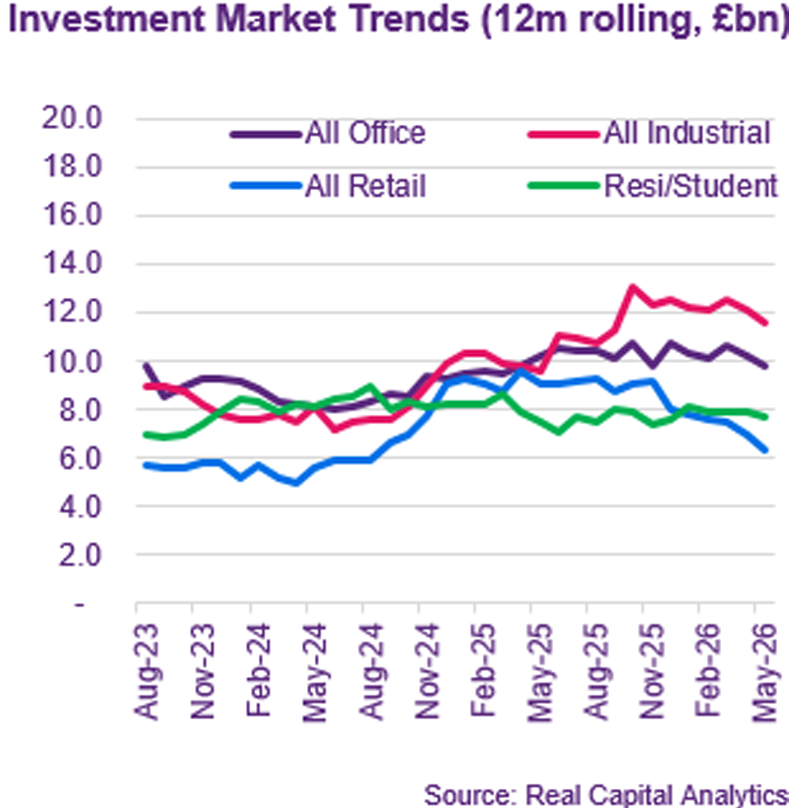
Preliminary data from Real Capital Analytics (RCA) illustrate how quiet the investment market was in May, with just £1.2bn of reported transactions completed. That would represent the weakest month since the depth of the pandemic lockdowns in 2020. The year-to-date total of £13.7bn is almost a quarter down on the equivalent period last year.
The largest deal to complete in May was £200m from ICG to acquire the Springbox logistics portfolio from the Equities Property Fund of South Africa. The portfolio comprises almost 1 million sq ft across 5 distribution warehouses let to the likes of DHL and Evri. The assets which were reportedly previously under offer to P3 Logistics Parks, deliver an initial yield of c5.5% but also promise significant reversion.
The largest single-asset deal to close in the month was the sale of Vintners Place in the City for £105m. Purchasers Castleforge and Fortress have been targeting well-located grade B office stock with refurbishment potential. Previous owners Goldman Sachs and Greycoat acquired the asset in 2018 for £160m and tried to sell it for £208m in 2022. Lender JP Morgan had since taken over Goldman Sachs’ interest in the asset.
There was very limited activity in regional office markets, but RCA report that Fidelity have sold Fusion Point 1 & 2 in Cardiff for £16m. Fidelity acquired the assets separately in 2014 and 2017 for a combined £20m before completing a refurbishment. In Liverpool, the former HQ of Merseyside Police was acquired by Homes England for £17m, with plans to deliver a mixed-use development on the waterfront site. |
Market yields
Medium-term interest rates have remained broadly flat over the last month, with 5-year swaps at 4.2% at the time of writing. The swap curve implies that markets were expecting one 25bp rate hike late this year and another one in early ’27. The benchmark 10-year Gilt remains elevated at 4.9%.
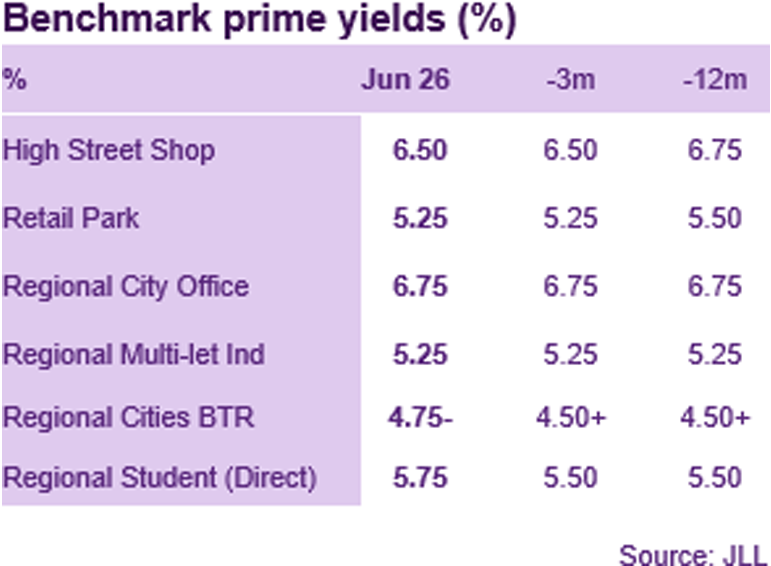
With expectations of higher rates now firmly entrenched, benchmark yields are showing signs of softening, particularly in the Living sectors. JLL report that BTR yields have softened drifted out across all benchmarks, most notably prime and secondary regional which have moved out by 25bp to 4.75% and 5.25% respectively. The Prime London benchmark is clinging on at “4.25%+” but there is no obvious transactional evidence to support that level.
Student accommodation yields have been under pressure for some time. Direct-let benchmarks for Inner and Outer London softened by 25bp to 4.75% and 5.0% respectively, whilst prime benchmarks for leased assets in London have moved out by 25bp over the last month, and by 50bp since March. In contrast, the >£125m West End Office benchmark is the only one of 50+ benchmarks that JLL expect to harden in the short-term.
|
Auctions
Allsop’s commercial auction in June raised total proceeds of £25.5m, 30% less than the equivalent auction last year. The May auction (£30.3m raised) was also 15% down on the 2025 equivalent. This contrasts with the optimism from the March auction which raised £63m from sales, the highest total for two years.
The largest lots appear to have been particularly hard to shift at auction; of 12 lots available on the day with guide prices above £1m, 9 were still available at the time of writing. However, Allsop report that six other lots did achieve sale prices of £1m+ outside of the auction room. Many of these had residential aspects; most notably 4 vacant commercial units in Wandsworth with 7 flats above sold prior to the auction for £3.3m, representing a gross yield of c5%. |
Market forecasts
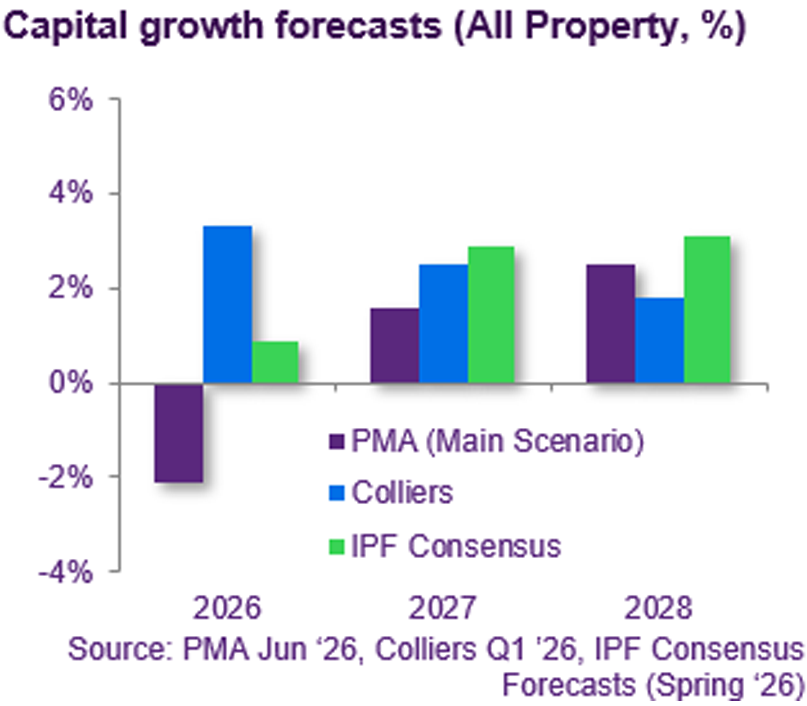
The latest forecasts from leading independent forecaster PMA are based on expectations of weak economic growth this year and next, with GDP growth of 0.5% and 0.8% respectively. PMA now anticipate that average commercial property values will end 2026 2.1% lower than they started it. However, they expect the modest recovery seen in 24/25 to resume from next year.
PMA are more optimistic when it comes to Central London offices, predicting capital growth of 3.1% this year and a cumulative 19.8% by 2030. They expect this robust value appreciation to be driven entirely by rental growth. In contrast, PMA predict that regional office values will be lower in 2030 than they are today despite anticipating a continuation of moderate rental growth.
Expectations for the Retail sector over the next 5 years are varied. PMA anticipate outperformance for Central London, with strong rental (14.2%) and capital growth (18.6%), and more moderate growth for Retail Warehouses and London Suburban Retail. In contrast, they are forecasting flat rents and further valuation declines for smaller high streets and secondary shopping centres.
Rental growth expectations for the Industrial sector have been steadily slowing, and whilst they remain positive, this is starting to feed through into more moderate capital growth forecasts, with just 6.7% expected over 5 years. |
|
Looking forward
The Consensus forecasts compiled by the IPF illustrate the market’s differing expectations for key commercial sub-sectors. As has been the case for many years, the Industrial sector is expected to outperform from a capital growth perspective, whilst Central London Offices also attract optimism. In contrast, the Retail sub-sectors are all expected to underperform the market average on this metric. This appears to reflect the expected hierarchy from a rental value growth perspective: Industrial (3.0% p.a.) and Central London offices (3.0-3.2%) to outperform, leaving Standard Retail (2.3%), Retail Warehouses (2.2%) and Shopping Centres (1.5%) in their wake. However, the delta between the best and worst performing sectors would be far narrower than has been the case for a fair few years and crucially is narrower than is implied by cap rates in the respective sectors. When switching focus to a total return basis (including both income return and capital growth) the hierarchy is turned on its head. Shopping Centres are predicted to outperform (8.2% p.a.), closely followed by Retail Warehouses (8.0%), leaving Industrial (7.2%) and Central London Offices (6.6-7.1%) trailing.
Forecasts are just that of course, and even if they prove to be unusually accurate, most investors will not deliver the market average. That is because the range of returns within any given sector can be wide and are likely to be even wider than usual over the coming years. This is certainly true of the Retail sector where there are still a substantial minority of assets that have no long-term future in our digital-oriented world. Some secondary shopping centres are still being traded at very significant double-digit yields, and such prices reflect a genuine risk that such assets may in fact become liabilities. Similarly, many high street units in smaller towns need to find alternative uses and will certainly never regain institutional demand as retail assets. In contrast, the strongest shopping centres are once again attracting competitive bidding from tenants, Retail Parks have secured a highly valuable niche in omni-channel process maps, and convenience retail has demonstrated through-the-cycle resilience and insulation against online penetration. |
Visit us
Discover a wealth of
real estate expertise, regardless of your business level or stage.

Author
Tom Sharman
Head of Strategy
NatWest Real Estate Finance
|
|
 |
|
Property Perspectives Series 2 — Where the market is really heading
We’ve brought together leading voices across retail, offices, industrial and residential to share where value is moving and debate what comes next.
Quick, expert-led discussions to sharpen your views.
→ Catch up now
|
|
If you would like to opt out, please get in touch with your Relationship Manager.
This document has been prepared by National Westminster Bank Plc or an affiliated entity (“NatWest”) exclusively for internal consideration by the recipient (the “Recipient” or “you”) for information purposes only. This document is incomplete without reference to, and should be viewed solely in conjunction with, any oral briefing provided by NatWest. NatWest and its affiliates, connected companies, employees or clients may have an interest in financial instruments of the type described in this document and/or in related financial instruments. Such interests may include dealing in, trading, holding or acting as market-maker in such instruments and may include providing banking, credit and other financial services to any company or issuer of securities or financial instruments referred to herein. NatWest is not and shall not be obliged to update or correct any information contained in this document. This document is provided for discussion purposes only and its content should not be treated as advice of any kind. This document does not constitute an offer or invitation to enter into any engagement or transaction or an offer or invitation for the sale, purchase, exchange or transfer of any securities or a recommendation to enter into any transaction, and is not intended to form the basis of any investment decision. This material does not take into account the particular investment objectives, financial conditions, or needs of individual clients. NatWest will not act and has not acted as your legal, tax, regulatory, accounting or investment adviser; nor does NatWest owe any fiduciary duties to you in connection with this, and/or any related transaction and no reliance may be placed on NatWest for investment advice or recommendations of any sort. Neither this document nor our analyses are, nor purport to be, appraisals or valuations of the assets, securities or business(es) of the Recipient or any transaction counterparty. NatWest makes no representation, warranty, undertaking or assurance of any kind (express or implied) with respect to the adequacy, accuracy, completeness or reasonableness of this document, and disclaims all liability for any use you, your affiliates, connected companies, employees, or your advisers make of it. Any views expressed in this document (including statements or forecasts) constitute the judgment of NatWest as of the date given and are subject to change without notice. NatWest does not undertake to update this document or determine the accuracy or reasonableness of information or assumptions contained herein. NatWest accepts no liability whatsoever for any direct, indirect or consequential losses (in contract, tort or otherwise) arising from the use of this material or reliance on the information contained herein. However, this shall not restrict, exclude or limit any duty or liability to any person under any applicable laws or regulations of any jurisdiction which may not be lawfully disclaimed. The information in this document is confidential and proprietary to NatWest and is intended for use only by you and should not be reproduced, distributed or disclosed (in whole or in part) to any other person without our prior written consent.
National Westminster Bank Plc. Registered in England & Wales No. 929027. Registered Office: 250 Bishopsgate, London EC2M 4AA. National Westminster Bank Plc is authorised by the Prudential Regulation Authority, and regulated by the Financial Conduct Authority and the Prudential Regulation Authority.
|
|
|