If you cannot see the graphic or access the links within this message please go to the source
|
 |

Ill wind for developers delivers rental windfall for standing stock
Times can scarcely have been harder for developers at any time since the depth of the Global Financial crisis, almost 20 years ago. Across the full range of commercial and residential sectors viability is being squeezed relentlessly by build cost inflation on the one hand and softer exit values on the other. Regulation, however well intentioned, has increased complexity, lengthened timescales and created uncertainty.
The planning environment remains onerous and decisions can seem fickle, with the appeals process prolonging uncertainty. Finance can also be challenging, as lenders must take a conservative view on costs, timings and end values, yet rising interest rates can demand heroic assumptions to make the numbers all stack up.
The country’s need for more new homes is widely acknowledged, yet economic growth also requires modern office stock, affordable workspace, cutting edge factories and labs and efficient logistics networks. But developers will only take on the significant risk of such projects if an appropriate profit margin can be confidently predicted for their trouble. |
This confidence is clearly in short supply. The latest data from NHBC shows that new home registrations in Q3 were 13% down year-on-year, whilst data from Glenigan show that the value of residential starts in the 3 months to October was down by around 30% for both private and social housing.
As for non-residential construction, Glenigan data show a 20% year-on-year decline, whilst sector-specific agency data for offices and logistics also show weakening activity at a market level. These are all disappointing trends from the national socio-economic perspective, but there is a rather significant silver lining for owners of high-quality stock.
Results from listed property companies illustrate this point clearly. Residential landlord Grainger announced “high occupancy, strong lease up of our new schemes and strong like-for-like rental growth”.
In the office sector, Landsec, BL, GPE, Derwent London all report above inflation rental growth, citing the shortage of new supply, whilst the industrial specialists reported strong net income growth despite the subdued economic backdrop. |
|
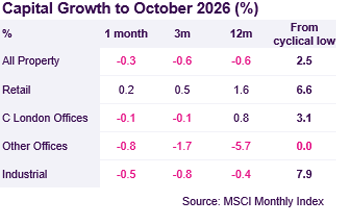
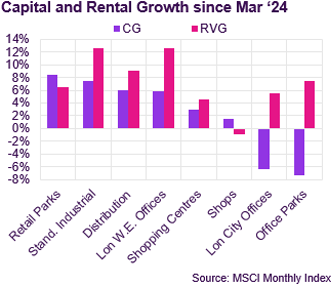
Commercial property returns According to MSCI, the recent gradual decline in commercial property values picked up pace in October, with average values coming off by 0.3%. After eight successive months of marginally negative capital growth, values are now, on average, around 1% lower than they were when the halting recovery petered out in February.
The Retail sector continues to demonstrate the most resilience, with capital values edging up by a further 0.2% in October, taking year-to-date growth to 1.3%. This capital growth has largely been driven by Central London and retail parks (up by 6.3% and 1.8% YTD respectively). In contrast, rental growth has been broader based (+1.8% YTD on average).
The relatively low yielding Industrial sector has started to feel the impact of higher interest rates, with capital values off by 0.5% in October and by 1.2% since May. Rental values are still growing at a healthy pace, up by 0.4% in October, and by 3.1% YTD, yet the underlying trend has been one of steadily slowing rental growth since 2022.
The office sector continues to present a mixed picture. London West End capital values are up 1.3% YTD and by 6.7% from their 2024 low point. In contrast, all other regions remain at cyclical lows, including London City (down by 2.7% YTD). The rental picture is more positive, with all regions except the South East recording positive rental growth this year. |
|
Investment market activity
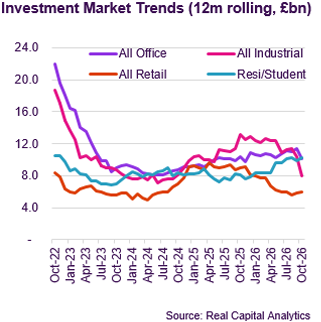 Preliminary data from Real Capital Analytics (RCA) suggest that £3.0bn of transactions completed in October, broadly in line with the monthly trend this year. The YTD total of £32.7bn is almost 25% lower than the equivalent period last year, whilst Industrial sector investment is down by 45%.
Comfortably the largest deal in October was the £1.1bn commitment by New York-listed CareTrust REIT to acquire 45 care homes from UK sector-specialist LNT developments. 24 homes are currently operational, the other 21 are under development. All 45 will initially be leased and operated by LNT. This is the third major UK acquisition by CareTrust since 2025.
The resurgence in shopping centre investment continued, with the purchase by LandSec of the MetroCentre in Gateshead, the fourth largest shopping complex in the UK. The purchase price of £516m represents an initial yield of almost 8%. LandSec also acquired a further 10% share of Bluewater for £95, taking their overall share in the asset to 74%.
In another generally quiet month for the office sector, there were three notable deals in regional cities. Local Pension Partnership’s Real Estate Fund acquired the Globe in Manchester from Aviva Investors for a reported £45m. Praxis advanced their regional office strategy with the £39m purchase of the Alpha Tower in Birmingham at a yield of 10%. Lloyds Bank’s Cardiff office at 1 John Street was sold for £38m (7.3% yield).
Retail Parks have increasingly been attracting investment from diverse sources, and the Church Commissioners continued this trend, with the acquisition of Beck retail Park in Wakefield. The purchase price of £34.1m (7.0% yield) is about 10% lower than the previous trade 8 years ago |
Market yields Medium-term interest rates have edged up again over the last month, putting more upward pressure on property yields. At the time of writing, the five-year SONIA swap rate is almost 4.8%, up by over 100bp since Q1. The 10-year Gilt yield, a widely used reference point for institutional investors, breached the 5% mark in April for the first since 2008 and is now close to 5.4%.
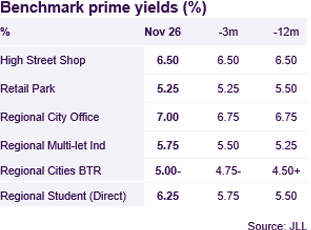
Lower yielding sectors are most exposed to higher rates, and JLL report significant movements in a range of residential benchmarks. Direct Let Student benchmarks softened by 25bp in the last month and prime regional yields have now moved out by 75bp since March. This followed a 25bp outward shift for all Build-to-Rent benchmarks in October.
The Industrial sector, with prime benchmarks at 4.75%-5.25% in the summer now range from 5.0%-5.75%, following a further 25bp outward shift for regional benchmarks over the last month.
JLL have flagged 32 of 52 benchmark yields as experiencing weakening sentiment. The only sub-sector where yield compression remains a short-term prospect is prime shopping centres, where a combination of relatively high yields, stabilising rents and resurgent investor demand offer support. |
Auctions
The October commercial property auction held by Allsop raised £76m of sales proceeds, the highest in any single auction since 2022. With one auction left this year, the annual total is set to exceed the 2025 proceeds of £350m but will lag a long way behind the £500m mark exceeded in both 2021 and 2022.
Despite the strong October outcome, higher value lots struggled, with four of the five highest priced lots failing to sell. The odd one out, selling for £1.8m, ticked a lot of private investor boxes; a retail parade in Bristol, anchored by Tesco until 2035, with 6 flats above and a day one yield in excess of 8%.
Although raising less overall (£36m), Allsop’s November auction saw more success on the largest lots. Most notably a mixed-use asset in Southampton, secured by long income to Tesco and the Gym Group (£4.1m, 10.7%), and a mixed-use block in Liverpool anchored by the Z Hotel (£3.2m, 11.7%). |
Market forecasts
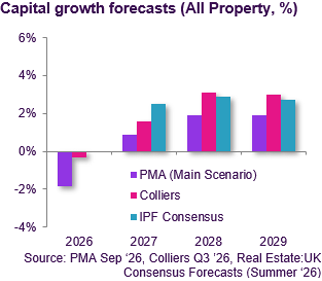
Independent forecasters PMA updated their forecasts in September. PMA predict that capital values will end the year slightly lower than they started it, whilst recovery over the next three years will be tepid (c5% cumulative). Nonetheless, they forecast steady rental growth across all sectors.
Over the next 3 years PMA expect Central London offices to significantly outperform, with capital growth of c15%, backed by rental growth of c12%. In contrast, smaller office markets outside London and the major regional cities are expected to see further gradual valuation declines throughout the 3-year horizon, despite also expecting positive rental growth.
The Industrial sector, for a long-time the outstanding performer, is expected to deliver only moderate capital growth over the next three years (c4%) following a minor interest-rates driven correction this year (-3.5%). Forecast rental growth over the next 3 years, whilst positive (c1.5% p.a.), would be considerably lower than recorded over the last 3 years (c5.5% p.a.)
PMA’s growth forecasts for the Retail sector are mixed. London and Retail Parks are predicted to outperform, whilst secondary shopping centres and small-town high streets are expected to continue to underperform. |
|
Looking forward
Market data from MSCI suggest that all mainstream commercial sectors have seen persistent rental value growth over the last few years despite an unexciting backdrop for occupier demand. Leading independent forecaster PMA expects these positive rental trends to continue over the next five years, even though their underlying economic base case scenario is undemanding. Their optimism on rents is also incredibly broad-based. Of 34 sub-sectors forecast, PMA expect all but one to deliver positive average rental growth in each of the next five years. The sole exception being smaller high streets which are expected to continue to experience gradual structural decline.
This outlook at a market level is clearly one of moderate demand meeting very weak new supply, with rental growth being underwritten by scarcity rather than strength of demand. The net effect of this is that rents will continue to rise sharply for the small amounts of top-quality modern stock that are delivered to market, but that active tenant demand elsewhere will be thin, decision-making slow and tenant inertia high. This should benefit owners of good quality existing stock who are able to retain tenants without the potentially drawn-out and often expensive re-letting process. In contrast, leasing risk for older stock will become more elevated as many tenants will simply choose to roll short-term extensions rather than committing to long new leases or going through the hassle and expense of moving to another property that may be little better than their existing space
Landlords with vacant space essentially face three choices. A – Gamble and spend big on redevelopment to try and attract top rents. B – Go for a light-touch refurb and fit out that is just good enough to attract tenants at a higher rent that is still a significant discount to new space. C – Try to avoid cap ex altogether and simply compete on price. None are without risk, and the weaker the location, the less capex can be justified and the fewer options exist. |
Visit us
Discover a wealth of
real estate expertise, regardless of your business level or stage.

Author
Tom Sharman
Head of Strategy
NatWest Real Estate Finance
|
|
|
If you would like to opt out, please get in touch with your Relationship Manager.
The Royal Bank of Scotland plc, The Royal Bank of Scotland N.V, or an affiliated entity (‘RBS’) and for the purposes of Directive 2004/39/EC has not been prepared in accordance with the legal and regulatory requirements to promote the independence of research. Regulatory restrictions on RBS dealing in any financial instruments mentioned at any time before this document is distributed to you do not apply. This document has been prepared for information purposes only. It shall not be construed as, and does not form part of an offer, nor invitation to offer, nor a solicitation or recommendation to enter into any transaction or an offer to sell or a solicitation to buy any security or other financial instrument. No representation, warranty or assurance of any kind, express or implied, is made as to the accuracy or completeness of the information contained herein and RBS and each of their respective affiliates disclaim all liability for any use you or any other party may make of the contents of this document. The contents of this document are subject to change without notice and RBS does not accept any obligation to any recipient to update or correct any such information. Views expressed herein are not intended to be and should not be viewed as advice or as a recommendation. RBS makes no representation and gives no advice in respect of any tax, legal or accounting matters in any applicable jurisdiction. This document is not intended for distribution to, or use by any person or entity in any jurisdiction or country where such distribution or use would be contrary to local law or regulation. The information contained herein is proprietary to RBS and is being provided to selected recipients and may not be given (in whole or in part) or otherwise distributed to any other third party without the prior written consent of RBS. RBS and its respective affiliates, connected companies, employees or clients may have an interest in financial instruments of the type described in this document and/or in related financial instruments. Such interest may include dealing in, trading, holding or acting as market-makers in such instruments and may include providing banking, credit and other financial services to any company or issuer of securities or financial instruments referred to herein. The Royal Bank of Scotland plc. Registered in Scotland No. 90312. Registered Office: 36 St Andrew Square, Edinburgh EH2 2YB. The Royal Bank of Scotland plc is authorised by the Prudential Regulation Authority and regulated by the Financial Conduct Authority and Prudential Regulation Authority. The Royal Bank of Scotland N.V., established in Amsterdam, The Netherlands. Registered with the Chamber of Commerce in The Netherlands, No. 33002587. Authorised by De Nederlandsche Bank N.V. and regulated by the Authority for the Financial Markets in The Netherlands. Agency agreements exist between different members of The Royal Bank of Scotland Group plc.
© Copyright 2026 The Royal Bank of Scotland plc. All rights, save as expressly granted, are reserved. This communication is for the use of intended recipients only and the contents may not be reproduced, redistributed, or copied in whole or in part for any purpose without The Royal Bank of Scotland plc’s prior express consent.
|
|
|