Business size has emerged as a much stronger predictor of AI adoption than their geographic location. Firms with more than 100 employees are nearly twice as likely to use AI as smaller businesses, at 67% compared with 36%. Region accounts for only 8% of the variation in AI use, compared with 39% for headcount and 24% for turnover.
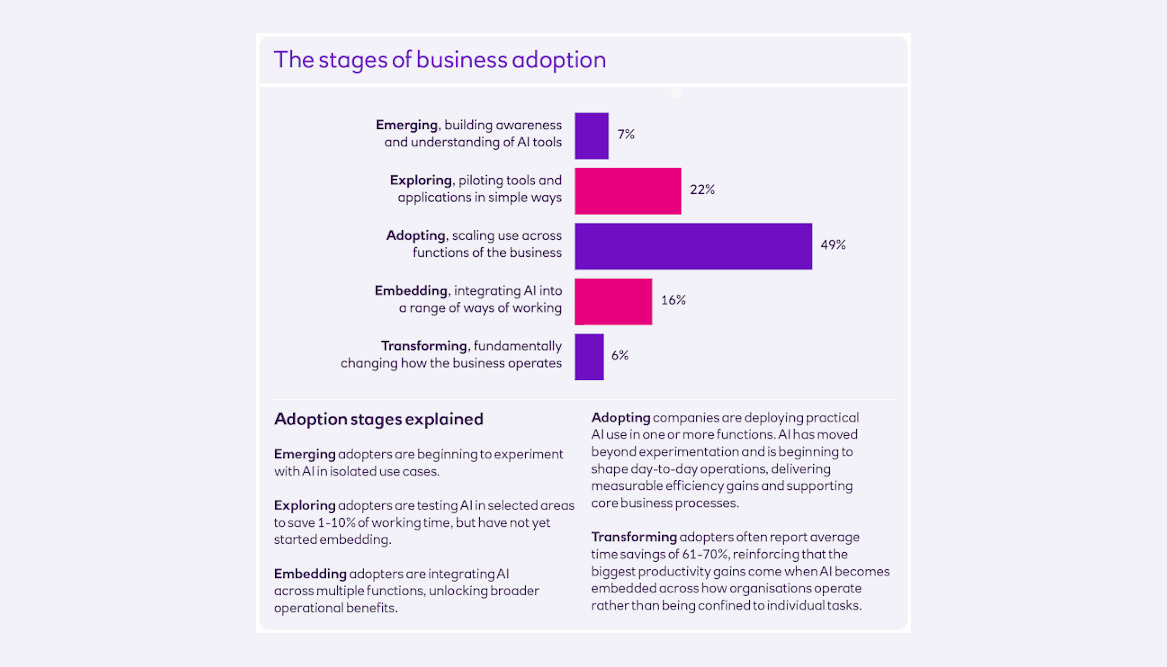
The gap matters because the benefits increase sharply as adoption deepens. Businesses at the earliest exploring stage typically report saving 1% - 10% of working time, while those at the transforming stage often report average savings of 61% to 70%. 95% of businesses at the transforming stage also report increased revenue, compared with less than 29% for those businesses at the earliest stage.
Seb Burnside, Chief Economist at NatWest said: “The opportunity from AI is not confined to the UK’s major technology centres. With size and scale a much stronger predictor of AI adoption, the regional growth story will be shaped less by where a business is based and more by the conditions around it – its access to skills and expertise, the confidence of its leaders and the strength of its local industrial base. Every nation and region has the potential to benefit, but turning that into growth will depend on creating the right local environment for businesses of all sizes to adopt AI successfully.”
Kanishka Narayan MP, UK Minister for AI said:
“Putting AI to work can help businesses save time, raise productivity and unlock new opportunities for growth.
We must make sure firms of every size have the skills and confidence to move beyond experimentation and adopt the technology safely and successfully. Government will play its part, but businesses, banks and technology companies all have a role too. NatWest’s support will help more businesses make AI work for them.”
From technology adoption to customer-led growth
The findings, which are part of NatWest's first AI Adoption Report (PDF, 15 MB) suggests that access to AI technology alone will not determine which businesses succeed. The businesses most likely to benefit will be those that combine AI with people to create better customer experiences and build trust through transparency, protection and human accountability.
Additional research with over 2,400 of the bank’s Retail customers shows that people recognise the benefits of AI, with 74% of users saying it makes everyday tasks easier and 67% believing it can improve customer service.
But customers are equally clear about what will earn their trust. 81% say the ability to reach a real person when needed is the most important trust factor. Around three quarters want transparency about when AI is being used and how their data is handled, as well as strong independent regulatory oversight.
The findings suggest that customer trust will be critical to successful AI adoption. Businesses that deliver clear customer value while retaining human judgement, explaining how AI and data are used and building effective safeguards will be best placed to earn the confidence needed to scale AI adoption for growth.
Barriers to wider AI adoption
Barriers to widespread AI adoption remain, with businesses facing five key challenges as they look to move from experimentation to implementation:
- Skills gaps: Many businesses still lack the skills and expertise needed to deploy AI confidently, making talent, training and investment critical enablers of adoption
- Cost pressures: Smaller firms are often constrained by budgets and rely on free or low-cost tools, while larger organisations are more likely to have dedicated AI investment.
- Uncertainty over which tools to use: Many organisations are unsure which AI solutions will deliver the greatest value and how to scale beyond pilot projects.
- Limited in-house expertise and readiness: Technical capability, leadership decisions and organisational preparedness all play a crucial role in determining whether AI can be adopted effectively at scale.
- Security and governance concerns: Businesses need confidence that AI can be deployed responsibly, with the right oversight, safeguards and governance frameworks in place.
Together, these barriers highlight that successful AI adoption depends not just on access to technology, but on building the skills, confidence and organisational capability to use it effectively.
Robert Begbie, CEO, Commercial & Institutional Banking at NatWest, said:
“AI can be a powerful driver of growth, but success depends on more UK businesses moving beyond early experimentation and redesigning their business model around the needs of their customers. This is not simply about access to technology; businesses need the confidence, skills and capability to use AI to become more productive and deliver better customer experiences.
There is a real risk of an AI adoption divide, with smaller businesses facing greater barriers, including limited specialist expertise, skills and investment. NatWest’s role goes beyond financing: through our relationship managers, sector expertise, partnerships and networks, we can help more businesses turn the potential of AI into growth across the UK.”
New package of support for business AI adoption
NatWest is announcing a package of measures designed to help more businesses build the skills, confidence, connections and investment needed to adopt AI responsibly and at greater scale:
- 5,000 businesses upskilled on AI across NatWest Accelerator Community: NatWest Accelerator has announced the launch of 5,000 AI learning and adoption engagements over the next 12 months, providing practical learning and expert guidance through access to NatWest AI specialists.With a reach extending to around 32,000 entrepreneurs across 18 UK locations and our digital platform, NatWest Accelerator provides a powerful channel for building AI skills, confidence and adoption. The Accelerator community is on track to reach 50,000 members by the end of 2026, widening access to the expertise, networks and support needed to adopt and scale AI.
- Extension of successful Google Cloud Partnership – providing access to free Google Cloud credits for SMEs: The bank is extending its partnership with Google Cloud to help equip the next generation of UK innovators with the digital skills needed to unlock business growth. Google Cloud already supports entrepreneurs on NatWest’s Accelerator with access to AI tools, cloud technology, and expert training, and the renewed partnership will allow more businesses to attend specialist events, workshops and provide businesses with Google Cloud credits to test, develop and scale AI.
- Launching AI adoption pilot with the University of Lancashire: NatWest has partnered with University of Lancashire to deliver a dedicated three-part programme of AI events for mid-sized businesses. The pilot initiative will target around 350 businesses to help them better understand AI's potential and identify their own growth opportunities and address capability and implementation gaps.
- Expanding the Responsible AI network: NatWest's Responsible AI Network brings together businesses, academics and AI practitioners to share knowledge, explore best practice and support the responsible adoption of AI. The third event of the year is taking place in Manchester this month with the ambition to expand into additional regions next year, and help even more businesses adopt AI with confidence.
CUSTOMER CASE STUDY:
Transmission Dynamics: uses AI to improve critical asset and infrastructure resilience
North East engineering and technology company Transmission Dynamics describes itself as a fifth-stage “Transforming” business, using AI to help transform how critical assets and infrastructure is monitored and maintained.
A strong demonstration of this is through its Trains with Brains® approach, where the business combines AI, sensors and advanced engineering to turn complex operational data into actionable intelligence. Its PANDAS-V® system for example uses train-mounted cameras, wireless sensors and AI to monitor overhead electrical infrastructure, helping operators identify emerging issues before they develop into more serious failures.
The benefits are already being realised globally. Over an 18-month period, in one Network Rail region alone, intelligence generated by PANDAS-V® helped prevent at least six potential dewirements, incidents that can cost up to £1.5 million each. The technology has also helped them reduce their maintenance work bank by 18% and extend infrastructure inspection intervals from 11 weeks to 26 weeks, delivering estimated annual savings of around £2.5 million.
By embedding AI on top of their human derived engineering intelligence, Transmission Dynamics is helping customers move from reactive to predictive maintenance, improving operational resilience through real time reporting that enables quicker and better-informed decision-making.